128 Hz: Meaning Listening Context and the Limits of the Evidence
128 Hz is a measurable tone and clinical testing frequency; symbolic healing claims go beyond the evidence.
 Jonas ReedCalm Signal editor5 September 2026
Calm Signal · Frequency guide
128 Hz is a measurable tone and a familiar tuning-fork frequency. Claims that it aligns organs, clears karma or treats disease go far beyond what the evidence establishes.
In short
- 128 Hz means 128 cycles per second.
- Clinicians use 128 Hz tuning forks mainly to test vibration sensation; that does not make listening therapeutic.
- “Gateway to the soul” and “karmic cleansing” are symbolic interpretations.
- No robust clinical evidence shows that 128 Hz treats hypertension, arthritis, skin disease or organ dysfunction.
What the number means
A pure 128 Hz tone repeats 128 times each second and sounds low. A tuning fork produces a fundamental plus other acoustic components that decay over time. A music track labelled 128 Hz contains many frequencies, rhythm and timbre. Without measurement, the title may describe a drone, a tuning reference or a theme.
Listening through a speaker is not the same as applying a vibrating fork to the skin. Bone conduction, air conduction and mechanical vibration are distinct exposures.
Why 128 Hz appears in clinics
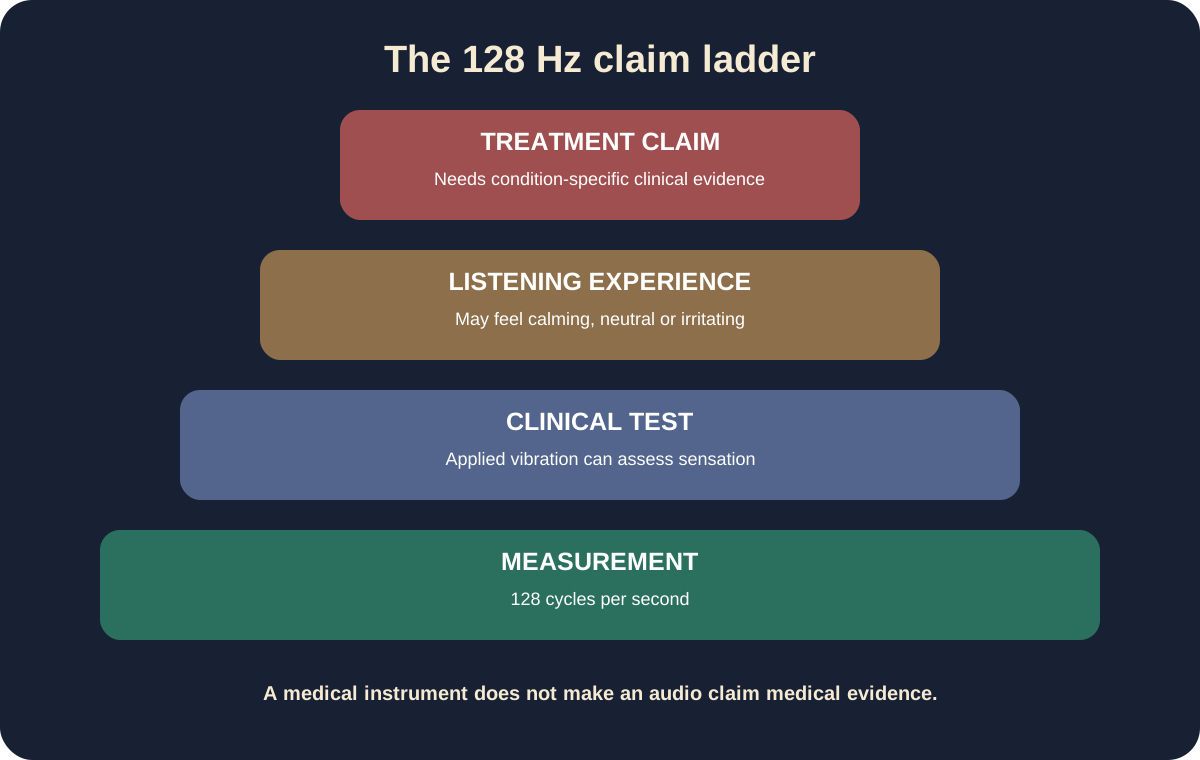
A 128 Hz tuning fork is commonly used during neurological or foot examinations because its vibration can test aspects of sensory function. The examiner applies it under standardised conditions and asks when vibration is felt or stops. This is an assessment tool with limitations, not a treatment for the nerve or body part.
The existence of a medical instrument can lend marketing credibility to unrelated audio claims. A thermometer is medical; listening to its beeps does not treat fever. The same distinction applies here.
Symbolic meanings
Modern wellness pages associate 128 Hz with alignment, synergy, “the gateway to the soul”, vital energy and karmic cleansing. These phrases may guide ritual or personal reflection. They are not anatomical descriptions and cannot diagnose blocked energy, damaged organs or emotional memory.
If a listener says the tone feels grounding, that experience is valid as a report. It may reflect pitch, volume, expectation, repetition, memory or the surrounding ritual. It does not demonstrate a universal frequency-specific mechanism.
Claims that require correction
Earlier promotional material connected 128 Hz with nerves, skin, bones, circulation, heart, lungs, kidneys, stomach and liver, and implied relevance to arthritis, hypertension, tachycardia, breathing irritation, digestion and weight. A list of body parts is not evidence. Each condition requires a defined intervention, comparison and clinically meaningful outcome.
There is no credible basis for saying the tone erases negative emotional memories or physically aligns the body. Trauma and disease should not be reframed as failure to receive a vibration correctly.
A responsible listening experiment
Set a modest aim such as creating a five-minute transition. Use a comfortable volume, stable posture and one recording for several sessions. Note relaxation, irritation, tinnitus or emotional response. Compare occasionally with another low, steady sound or silence so the label does not decide the experience in advance.
Stop if sound worsens pain, dizziness, tinnitus, migraine or distress. Do not place powerful vibrating devices on the body without device-specific safety guidance. Keep volume and duration within safe-listening limits.
How to test a 128 Hz study
- Was the exposure airborne sound or applied vibration?
- Were volume, duration and waveform reported?
- Was 128 Hz compared with a matched alternative?
- Was the outcome a symptom, sensory test or disease endpoint?
- Was the finding independently replicated?
A study of a diagnostic tuning fork, vibration therapy at another frequency or music in general cannot validate every claim attached to 128 Hz.