1618 Hz and the Golden Ratio: Acoustics Myth and Meaning
The golden ratio is a dimensionless proportion; 1618 Hz is an audible tone. Their link is a creative metaphor, not a demonstrated healing law.
 Jonas ReedCalm Signal editor5 September 2026
Calm Signal · Frequency guide
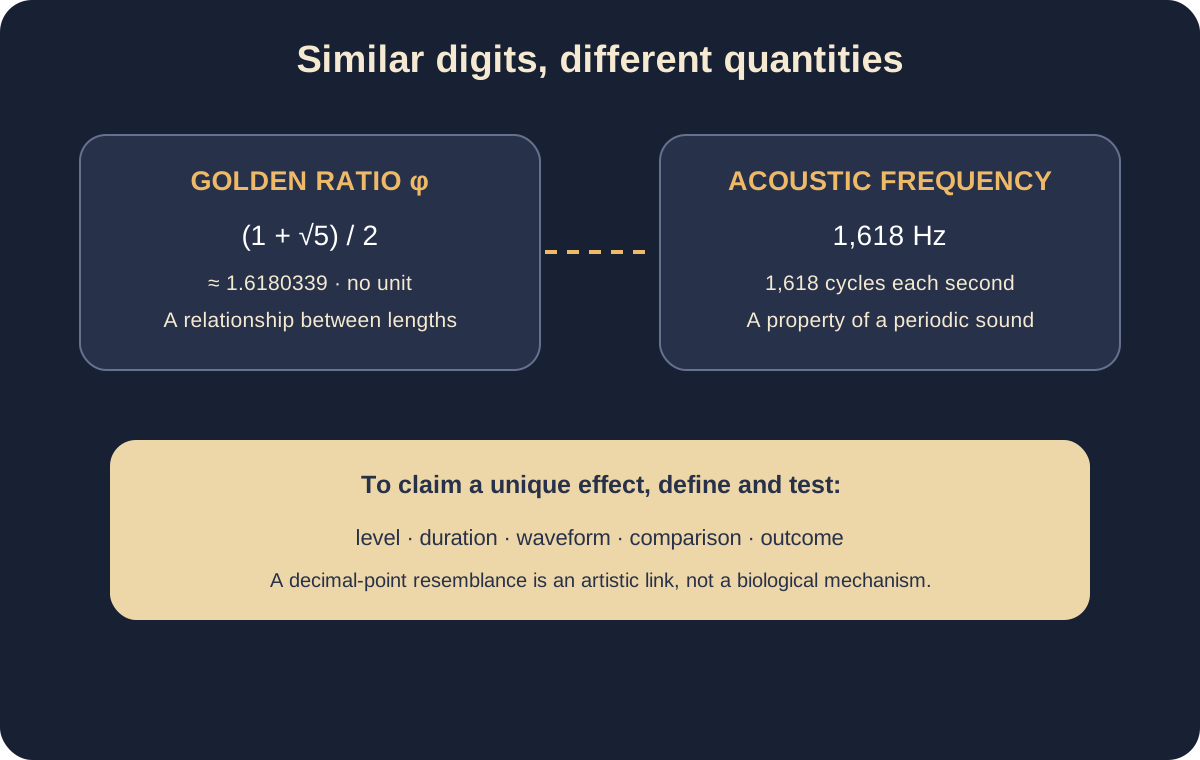
The golden ratio is a mathematical relationship of approximately 1.618. A tone at 1618 Hz is a separate acoustic choice. Joining the two can be a creative metaphor, but it is not a demonstrated law of healing or harmony.
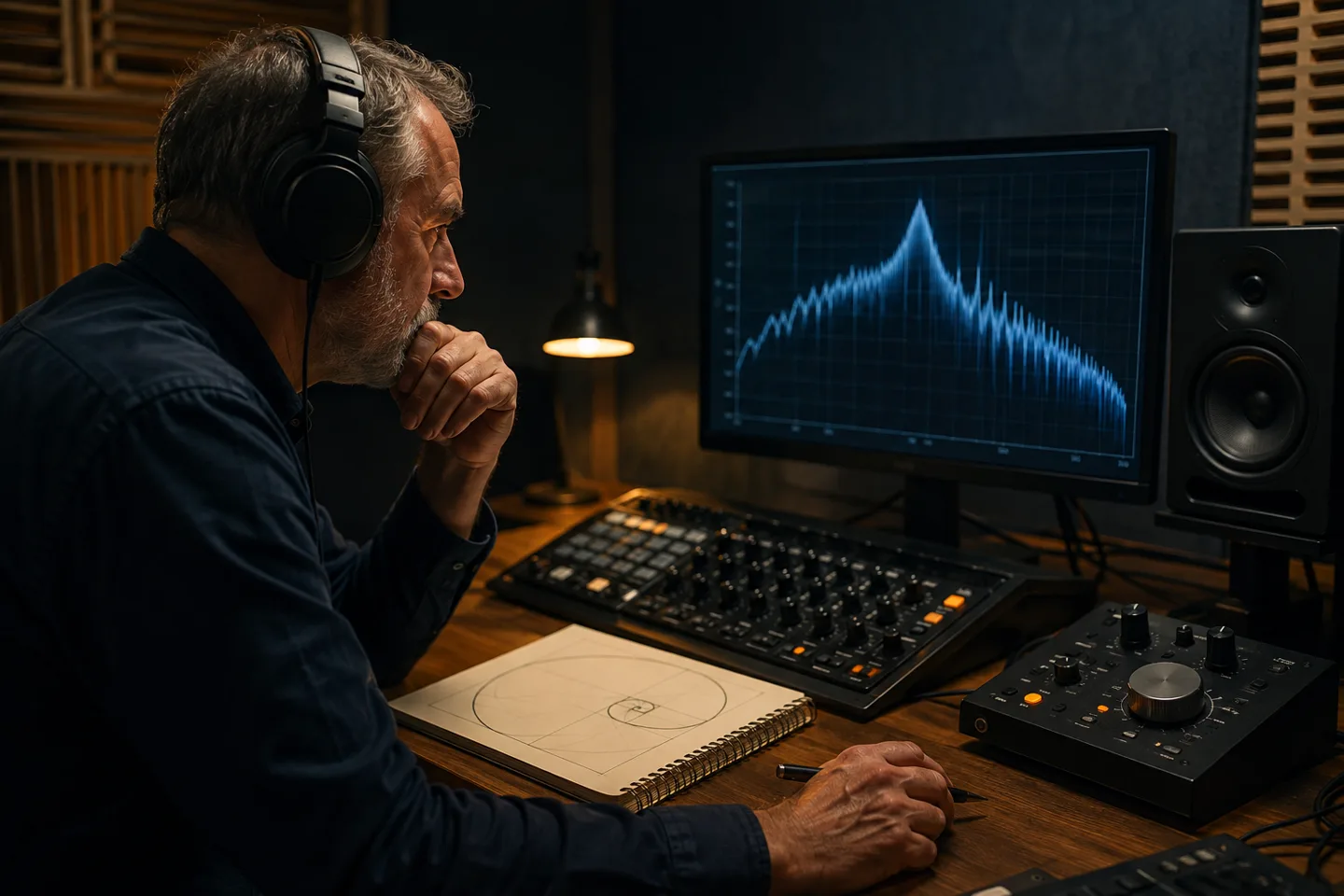
In short
- Phi equals (1 + √5) / 2, approximately 1.6180339.
- 1618 Hz means 1,618 acoustic cycles per second.
- Moving a decimal point from 1.618 to 1618 is a design decision, not a physical derivation.
- A listener may enjoy the symbolism without treating it as a clinical mechanism.
Two meanings hiding in similar digits
The golden ratio, usually written as phi, describes a proportion. Divide a line so that the whole compared with the longer part equals the longer part compared with the shorter, and that common ratio is phi. It is dimensionless: centimetres, pixels and metres cancel when one length is divided by another.
Hertz is a unit. The International System of Units defines Hz as reciprocal seconds. A 1618 Hz pure tone repeats 1,618 times each second. The digits resemble a rounded version of phi only after multiplying by one thousand and dropping the decimal point. Mathematics does not require that scaling.
What a 1618 Hz tone is like
1618 Hz lies in the audible mid-to-upper range. A pure sine tone can sound narrow and insistent, especially through headphones. In music, the labelled frequency may be a quiet component, a tuning reference, a carrier or simply the title of a composition. Timbre, rhythm, level, harmony and duration can matter more to the experience than one spectral peak.
Neither the number nor the label tells you the listening level. Begin low, avoid extended exposure to uncomfortable tones and stop if you notice pain, ringing, dizziness or headache. Hearing safety is governed primarily by sound level and duration.
The golden ratio is real; the mythology is optional
Phi appears in geometry, continued fractions and relationships involving the Fibonacci sequence. It also appears in some biological growth patterns and designs, but popular accounts often overstate how universal or exact those appearances are. Researchers have disputed the idea that phi is a universal formula for beauty.
That does not make the ratio meaningless. Designers and composers can deliberately use proportional relationships. A piece might organise durations, sections or intervals around a ratio as an artistic constraint. The result can be interesting without proving that human cells, emotions or “vital energy” are programmed to resonate with 1618 Hz.
Where the claim changes category
“I used phi as a compositional idea” is an account of artistic method. “The spiral reminds me to return to balance” is personal symbolism. “This track helped me settle” is an individual report. Each statement can stand on its own terms.
Claims that a 1618 Hz tone realigns organs, restores energy flow, guarantees clarity or improves decisions are health claims. They require controlled clinical evidence specific to the exposure and outcome. Evidence about attractive rectangles, Fibonacci spirals or music relaxation cannot be transferred automatically.
A five-minute listening experiment
- Choose a comfortable seat and use speakers if a pure tone feels sharp in headphones.
- Set the volume low before pressing play.
- Name a modest intention, such as observing breath or stepping out of task-switching.
- Listen for up to five minutes without forcing a particular state.
- Afterward, record comfort, mood and attention in ordinary language.
Repeat with another neutral track of similar loudness and duration on a different day. If the symbolic frame helps, that is useful personal information. It still does not reveal a unique biological action.
How to evaluate a “golden frequency” product
- Does it explain what 1618 Hz does in the actual audio?
- Are duration, format and headphone guidance clear?
- Are subjective intentions separated from medical outcomes?
- Does it avoid borrowed scientific vocabulary such as cellular resonance without measurements?
- Can the seller state what is unknown?
A responsible description offers a sound experience and a reflective theme. It does not convert a mathematical coincidence into certainty.
What a credible study would need
A useful experiment would match comparison tracks for loudness, duration, rhythm, timbre and expectation, changing only the frequency feature. It would define outcomes before collecting data, enrol enough participants, report adverse effects and replicate the findings. Blinding is difficult when tones sound different, so expectation must be measured.
Until such evidence exists, the most accurate position is modest: 1618 Hz is a sound; phi is a ratio; their connection is an artistic convention.