Attention Residue: Why Task Switching Has a Cost
After a task switch, part of the mind may remain occupied with what was left. A small closure ritual can make transitions cleaner.
 Maya ChenMind & Brain editor5 September 2026
Mind & Brain · Explainer
After you switch tasks, part of the mind may remain occupied with what you left. A small closure ritual can make transitions cleaner without pretending work can be interruption-free.

In short
- Attention residue describes thoughts about a previous task persisting after a switch.
- Unfinished, pressured or salient work can be harder to leave mentally.
- A visible next step and scheduled return point reduce uncertainty at the boundary.
- Batching helps, but the goal is fewer costly switches—not a fantasy of perfect focus.
The lag after the click
A calendar alert appears while you are solving a difficult problem. You join the meeting on time, yet part of your mind keeps rehearsing the sentence, calculation or disagreement you left behind. The body has changed tasks; attention has not fully arrived.
Management researcher Sophie Leroy used “attention residue” for this persistence of cognitive activity about Task A while a person performs Task B. In experiments published in 2009, transitions away from work could impair performance on the next task under certain conditions. The concept is useful, but it is not a diagnostic label or a universal law about every switch.
Why unfinished work sticks
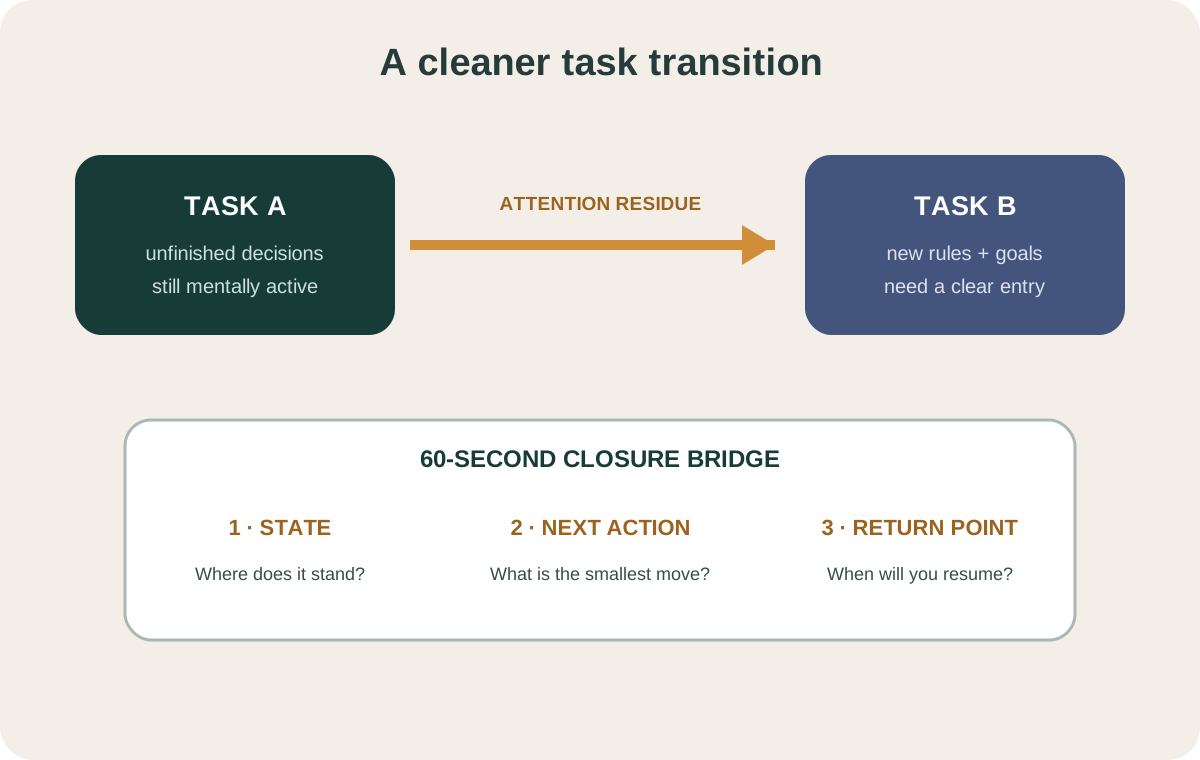
An unfinished task contains open decisions: where you were, what failed, what comes next and whether you will remember. Mentally rehearsing those details may feel protective. Salience increases when the work is important, emotionally charged or close to completion.
The switch itself also has a conventional cognitive cost. Different tasks require different rules, goals and response sets. The brain must inhibit one configuration and activate another. Attention residue adds the idea that content from the old task can remain active, not merely that new rules take time to load.
A 60-second closure ritual
- State: write one sentence describing where the work stands.
- Next action: name the smallest observable move, such as “compare rows 18–24” rather than “finish analysis”.
- Return: put the task on a calendar or trusted list with a realistic time.
If another person is waiting, record that dependency too. The note should let a future version of you restart without reconstructing the whole context. It is a handoff, even when both workers are you.
Protect the entry into Task B
Before beginning, define the output for the next block: a decision, draft, review or conversation. Close unrelated tabs and silence alerts for a bounded period. Spend the first minute reading the task’s restart note rather than opening every communication channel.
A ritual is not magic. If Task A involves genuine danger, conflict or urgent responsibility, the residue may be rational. Resolve or escalate the issue instead of trying to productivity-hack it out of awareness.
Batch by cognitive mode
Grouping similar actions—calls, approvals, short replies—reduces repeated reconfiguration. Protect longer blocks for synthesis, writing and analysis. Put office hours around channels that would otherwise remain continuously open. The exact schedule depends on the job; emergency and service roles need responsive pathways.
Distinguish self-initiated checking from necessary interruption. A notification audit often reveals many alerts whose urgency was assigned by software rather than by the work.
Do not turn focus into blame
Fragmentation is frequently structural: too many concurrent projects, unclear priorities, understaffing, constant meetings or norms of instant response. Individual rituals cannot repair an organisation that rewards interruption and then criticises slow deep work.
Teams can help by clarifying response-time expectations, using agendas and asynchronous updates, preserving no-meeting blocks and limiting work in progress. A shared system is more robust than asking everyone to exercise heroic self-control.
A practical experiment
For five workdays, mark each unplanned switch and rate restart difficulty from zero to three. Use the closure ritual for half the planned switches. At week’s end, look for patterns: particular people, channels, times or task types. Change one source of friction rather than adopting an elaborate productivity system.
Useful outcomes include time to regain the thread, errors, duplicated work and subjective strain. Total hours at a desk are a poor proxy for focused output.
Keep the claim proportionate
The original attention-residue experiments were influential but limited in scope. Work settings, tasks and people vary, and later research on interruptions includes multiple mechanisms. Use the idea as a design lens: if transitions are costly, make them fewer, clearer and safer. Do not use it to promise that one notebook technique will transform cognition.