Brain Synchronisation in Rhesus Macaques: What One Study Means
Three rhesus macaques, a motorised chair and simultaneous cortical recordings revealed brief cross-brain correlations tied to movement, distance and reward—not telepathy.
 Maya ChenMind & Brain editor5 September 2026
Mind & Brain · Study digest
Three rhesus macaques, a motorised chair and simultaneous cortical recordings revealed brief cross-brain correlations tied to movement, distance and reward. The experiment is technically striking—but it did not show telepathy or shared thoughts.
In short
- Researchers simultaneously recorded motor-cortex activity from pairs drawn from three adult female rhesus macaques.
- One animal rode a computer-controlled wheelchair to reach grapes while another watched and later received juice.
- Brief interbrain synchrony varied with movement, position, distance, reward and the identity or role of the pair.
- The small, invasive laboratory study explored social neural coordination; it cannot establish mind-reading, human empathy or a wellness benefit.
What was the experiment?
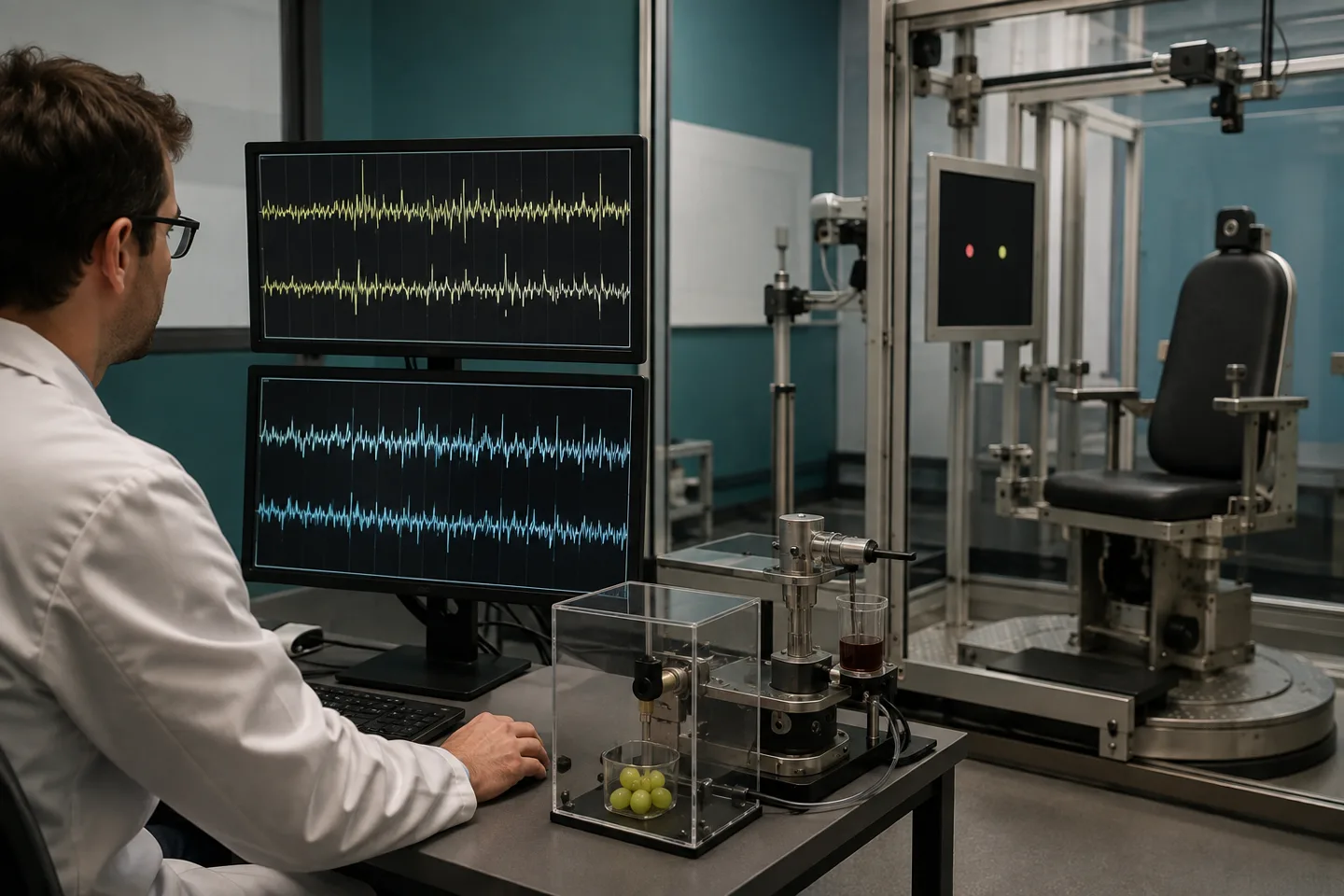
The 2018 study used pairs drawn from three adult female rhesus macaques, identified as C, K and J. The researchers had implanted multielectrode arrays in motor and premotor cortical areas and recorded neural activity wirelessly from two animals at the same time. The tested pairs were C–K and C–J, so this was not a broad sample of primate social life.
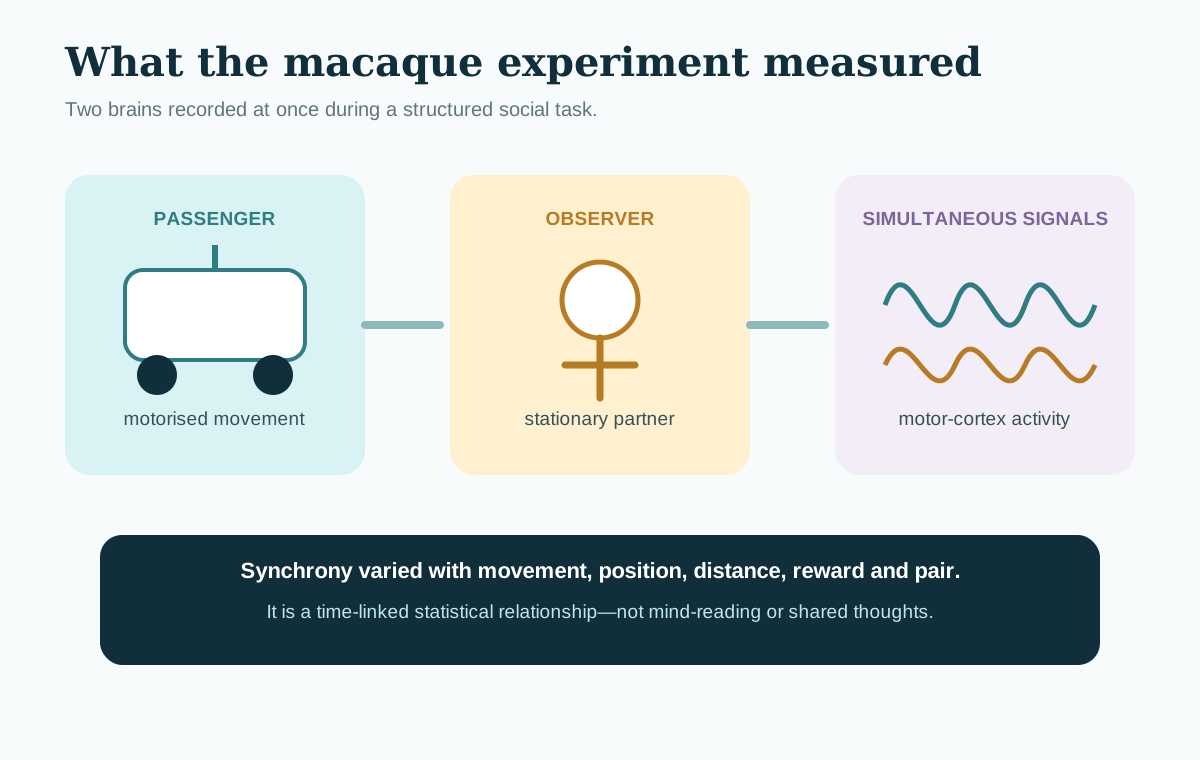
In each trial, the “passenger” sat in a computer-controlled motorised wheelchair. The chair moved along a programmed path toward a grape dispenser; after arrival, the passenger reached for grapes. The “observer” remained stationary and, after the passenger’s reward, received juice. The roles could change, creating a structured interaction with measurable movement, position, distance and reward events.
What does “interbrain synchrony” mean here?
The team compared patterns in neural population activity across the two recorded brains. At some moments, fluctuations were statistically coordinated. The paper describes this as episodic interbrain cortical synchronisation: it occupied about 19.7% of recorded session time for pair C–K and about 35.7% for pair C–J.
Those percentages do not mean that the animals shared a single brain state for one-fifth or one-third of the session. Synchrony depends on the analysis, time window and signals selected. It indicates that measured patterns covaried more than expected under the researchers’ model during certain periods.
What shaped the synchrony?
The correlations carried information about several parts of the task: whether and how the passenger was moving, the passenger’s position and velocity, the distance between the animals and the distance to reward. Pair composition and social role also altered the pattern. That specificity is scientifically interesting because it links cross-brain coordination to a changing social and physical scene rather than to a single repeated cue.
At the same time, many shared inputs can align brains. Both animals could see movement, anticipate reward, orient to the same apparatus and follow the same trial timing. The study’s value lies in analysing how two nervous systems participate in one interaction; it does not require a signal travelling directly from one mind to another.
What the result supports—and what it does not
| Supported by this experiment | Not established by this experiment |
|---|---|
| Simultaneous invasive recording during a controlled social task was feasible. | That one animal could read the other’s thoughts. |
| Cross-brain statistical relationships changed with task and social variables. | That synchrony is always empathy, cooperation or emotional bonding. |
| Motor and premotor populations reflected aspects of another animal’s movement. | That the result generalises to everyday human relationships. |
| Pair identity and role mattered. | That a product, sound or exercise can create therapeutic “brain alignment.” |
Why three animals is both useful and limiting
Non-human primate electrophysiology can record individual neurons and neural populations with spatial and temporal detail unavailable in most human social studies. The cost is a narrow sample, invasive preparation and an artificial task. Repeated observations from the same animals add data points but do not turn three individuals into a large population sample.
Species, sex, hierarchy, training history and apparatus may all influence the result. The authors reported pair-dependent patterns, which reinforces the need for replication across more animals, tasks and brain regions. Ethical interpretation also matters: scientific value should be weighed alongside animal welfare and the use of the least harmful method able to answer the question.
How this connects to brain–machine interface research
The laboratory had previously shown that rhesus macaques could navigate a motorised wheelchair using recorded cortical signals in a brain–machine interface. In the social experiment, the chair followed computer-controlled trajectories so the researchers could align both brains with the same events. This was a tool for controlling the task, not evidence that one animal steered the other.
Later work on joint action in macaques also found that neurons can represent aspects of a partner’s actions. Together, such studies support a view of the motor system as responsive to both one’s own actions and socially relevant observed actions. They do not erase the boundary between individual nervous systems.
Sources and further reading
- Interbrain cortical synchronization encodes multiple aspects of social interactions in monkey pairs (2018)
- Cortical control of a wheelchair by rhesus monkeys: brain–machine interface study
- Neuronal representation during joint action in macaques
- ARRIVE guidelines for transparent reporting of animal research