Brainwave Entrainment: What the Evidence Actually Supports
Rhythmic sound can evoke neural responses, but a measured response is not the same as a guaranteed benefit. Here is what brainwave-entrainment research supports—and where marketing runs ahead of evidence.
 Jonas ReedCalm Signal editor5 September 2026
Calm Signal · Evidence guide
Brainwave entrainment is often sold as if a tone can select a mental state on command. The real science is more interesting—and more modest. Rhythmic sound can evoke neural responses, while evidence for reliable benefits in anxiety, pain, sleep and cognition remains heterogeneous.
The short answer
- Auditory beats are real perceptual and physiological phenomena.
- A measured neural response is not automatically a meaningful improvement in mood, sleep or performance.
- Reviews report some positive average effects, but studies differ widely in frequencies, duration, controls and outcomes.
- The most credible use is as a low-risk listening ritual that may support regulation—not as medical treatment or guaranteed “frequency programming.”
What brainwave entrainment means
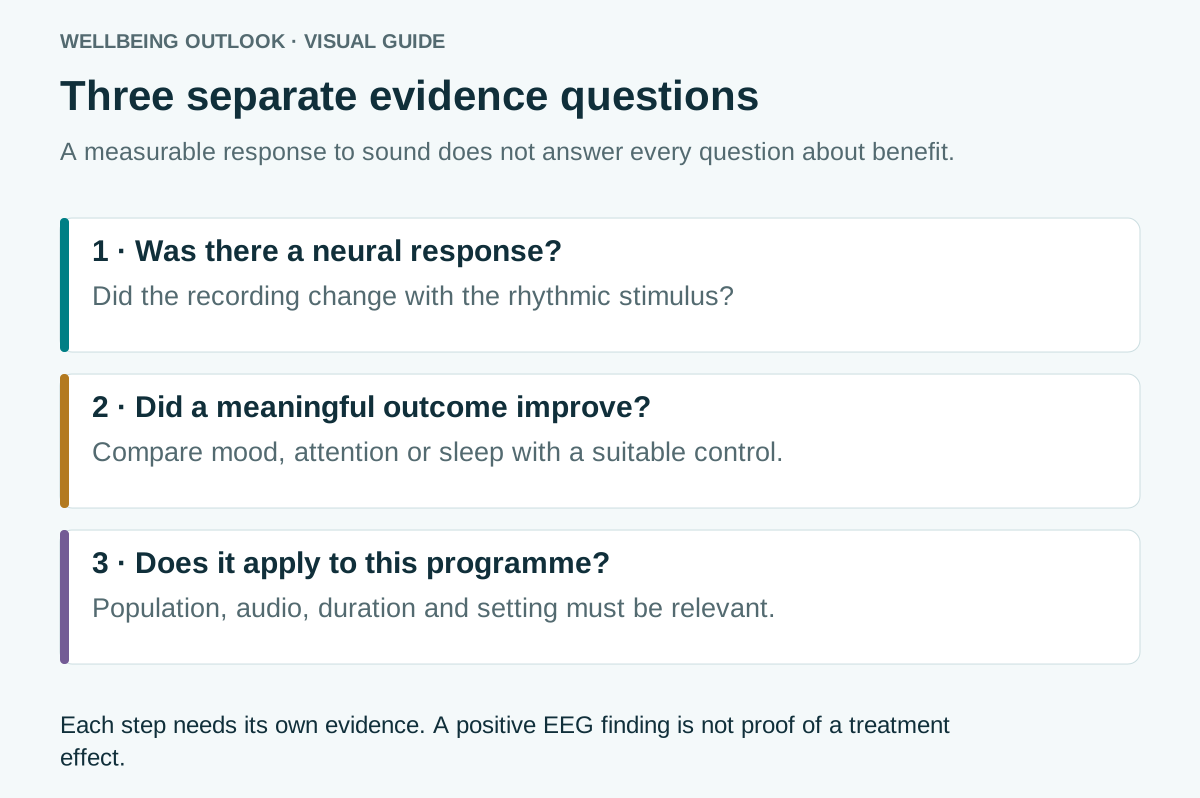
Entrainment is the tendency of a system to respond to a repeating rhythm. In auditory neuroscience, regularly modulated sound can produce time-locked neural activity called an auditory steady-state response. Researchers can measure that response with EEG or related methods.
The popular explanation often jumps from this fact to a larger claim: play a rhythm at a chosen rate and the listener’s entire brain will enter the matching psychological state. That leap is too large. The brain contains many simultaneous rhythms across many regions. A response to sound does not mean every network synchronises to one number, and synchronisation does not by itself prove relaxation, better memory or reduced pain.
Binaural, monaural and isochronic stimulation
Binaural beats
A binaural beat is heard when slightly different pure tones are presented separately to the left and right ears. If one ear receives 210 Hz and the other 200 Hz, the listener may perceive a 10 Hz fluctuation even though no physical 10 Hz tone is played. Stereo headphones are normally required to preserve the separation between ears.
Monaural beats
For a monaural beat, the two tones are combined before they reach the ears. Their interference creates an audible amplitude fluctuation in the sound itself. Both ears can receive the same signal, so speakers may reproduce it.
Isochronic tones
Isochronic stimulation uses a tone that switches or pulses on and off at regular intervals. The modulation is explicit and often more pronounced. It may be embedded beneath music or an ambient soundscape.
These methods are not interchangeable. A study of one cannot automatically validate the claims made for another, and details such as carrier tone, modulation depth, masking music, volume and exposure time matter.
What research has actually found
Anxiety and subjective calm
A 2019 meta-analysis pooling 22 studies reported an overall moderate effect across cognition, anxiety and pain outcomes. That result is encouraging, but a pooled average combines different protocols and populations. It does not tell us that every frequency works, that every listener responds or that the method treats an anxiety disorder.
A more recent systematic review of music and binaural-beat interventions in young adults found improvements in at least one outcome in many of the ten included trials, while explicitly warning that small samples and heterogeneous designs limit certainty. Expectation, the relaxing musical bed, time away from stressors and the listening context can all contribute to the experience.
Attention and memory
A 2023 meta-analysis focused on memory and attention reported a medium overall effect, but its systematic review found conflicting results, including inconsistent findings for theta and beta protocols. A 2024 review of auditory stimulation and autonomic arousal concluded that physiological and cognitive findings were mixed or insufficient for firm conclusions.
The sensible interpretation is neither “it has been debunked” nor “it optimises the brain.” Some protocols may help some outcomes under some conditions. The field still needs larger preregistered trials, credible placebo conditions and better replication.
Sleep
Sound can be part of a helpful wind-down routine, especially when it masks disruptive noise or creates a consistent bedtime cue. Evidence specific to binaural-beat entrainment remains less settled than marketing language suggests. Sleep is influenced by circadian timing, light, stress, substances, environment and health conditions; no frequency replaces those foundations.
Pain
Some trials and pooled analyses report changes in pain ratings. Pain perception is shaped by attention, expectation and arousal, so an audio intervention can plausibly alter the experience without acting as an anaesthetic or treating the cause. Persistent or severe pain needs appropriate clinical assessment.
Why studies are difficult to compare
Auditory-beat research has a design problem: it is hard to create a control sound that feels equally convincing yet lacks the feature being tested. Participants may guess which condition they received. Studies also vary in several ways:
- beat type and target frequency;
- carrier tones and whether music or noise masks them;
- listening before a task, during it or both;
- sessions lasting minutes versus repeated use over days;
- healthy volunteers versus people in a stressful clinical setting;
- self-report scales versus behavioural or physiological measures.
That variability is not a footnote. It is why a positive result for one protocol should not be used as blanket proof for every commercial track.
A claims ladder: what is fair to say?
| Claim | Evidence-aware wording |
|---|---|
| “The brain responds to rhythmic sound.” | Well established at a physiological level. |
| “Some auditory-beat protocols may affect anxiety, pain or cognitive performance.” | Reasonable, with study limitations stated. |
| “This 10 Hz track puts everyone into alpha.” | Too deterministic. |
| “A frequency treats anxiety, insomnia, ADHD or trauma.” | Not supported as a clinical treatment claim. |
| “A guided listening ritual may help you create conditions for calm.” | Appropriate when presented as support, not a guarantee. |
How to test a session without fooling yourself
- Choose one outcome. For example: “How settled do I feel after 15 minutes?” Avoid judging calm, creativity, sleep and memory at once.
- Keep the setting similar. Use roughly the same time, volume and posture across several sessions.
- Rate before and after. A simple 0–10 rating is more useful than relying on a dramatic memory.
- Compare. On another day, try quiet music or silence for the same duration.
- Watch the next hour. A session that feels intense but leaves you agitated is not serving the intended goal.
This personal experiment does not prove a medical effect, but it can answer the practical question that matters: does this ritual help you reliably transition?
Listening safely
Use a comfortable, moderate volume. The World Health Organization recommends keeping personal-device volume below about 60% of maximum and, where exposure can be measured, staying below an average of 80 dB. Louder sound sharply reduces safe listening time.
Do not use immersive relaxation audio while driving, cycling in traffic, operating machinery or in any situation that requires full environmental awareness. Stop if you experience pain, marked dizziness, nausea, panic, disorientation or a worsening of tinnitus. People with a known sound-triggered seizure pattern should discuss novel rhythmic-audio practices with their clinician; sound-induced reflex seizures are rare, but recognised.
Sources and further reading
- Garcia-Argibay et al. (2019): meta-analysis of binaural auditory beats
- Basu and Banerjee (2023): Binaural beats, memory and attention—systematic review and meta-analysis
- Chee et al. (2024): auditory stimulation, autonomic arousal and cognition
- Elnazer (2026): music and binaural-beat interventions in young adults
- World Health Organization: safe listening