Brainwaves and States of Mind: A Clear Introduction
Brainwaves are measurable patterns, not personality types or magic switches. A clear guide to alpha, beta, theta, delta and gamma—and why mental flexibility matters more than chasing one state.
 Maya ChenMind & Brain editor5 September 2026
Mind & Brain · Clear guide
Brainwaves are real, measurable patterns of electrical activity. But they are not personality types, magic switches or a diagnostic shortcut. Here is a practical map of what alpha, beta, theta, delta and gamma can—and cannot—tell us about a state of mind.
In short
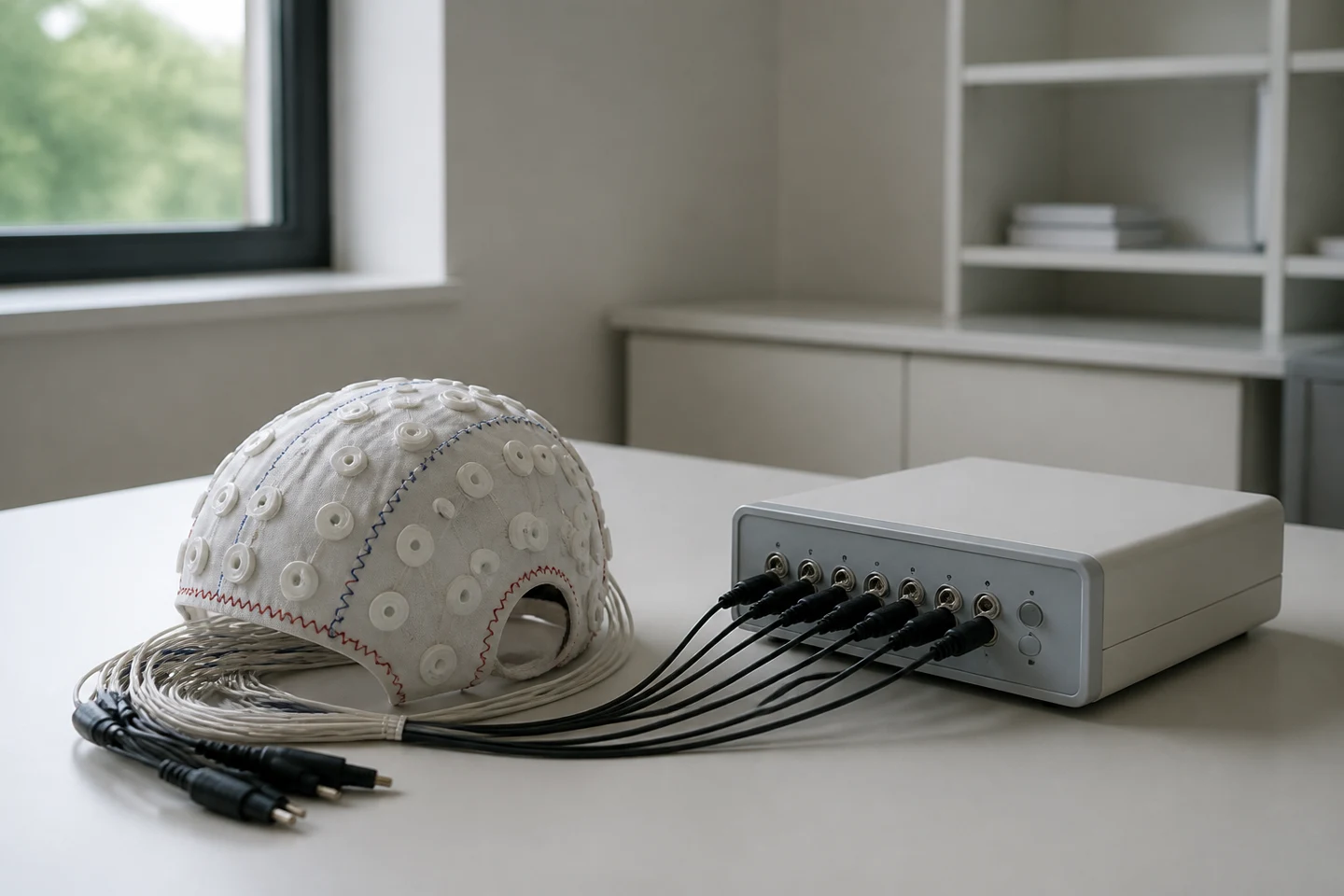
- An EEG records voltage changes at the scalp produced by large populations of neurons.
- Frequency bands are useful descriptions, but the brain produces several rhythms at once and their meaning depends on location, timing and context.
- Alpha is not simply “relaxed,” beta is not simply “stressed,” and theta is not a portal to the subconscious.
- The most useful goal is flexibility: being able to shift between alertness, rest, inward attention and sleep when the situation calls for it.
Your brain is an orchestra, not a switch
The phrase brainwave state makes the brain sound as though it selects one channel at a time. Real EEG recordings look nothing like that. They contain overlapping rhythms, brief events and non-rhythmic activity generated across different regions. What researchers call delta, theta, alpha, beta or gamma is a way of organising parts of that complex signal by frequency.
Frequency is measured in hertz: cycles per second. Amplitude describes the size of the recorded voltage change. Those two measurements are useful, but neither tells the whole psychological story. Two people can show different resting patterns and still both be healthy. The same person’s pattern changes with age, eyes open or closed, fatigue, medication, task demands and even the way the signal is analysed.
That is why a frequency label should be treated as a clue, not a verdict. Clinical EEG interpretation also considers where activity appears, how symmetrical it is, whether it reacts to events, and whether a waveform is expected for the person’s age and condition.
The familiar frequency bands
Delta: the slow end of the spectrum
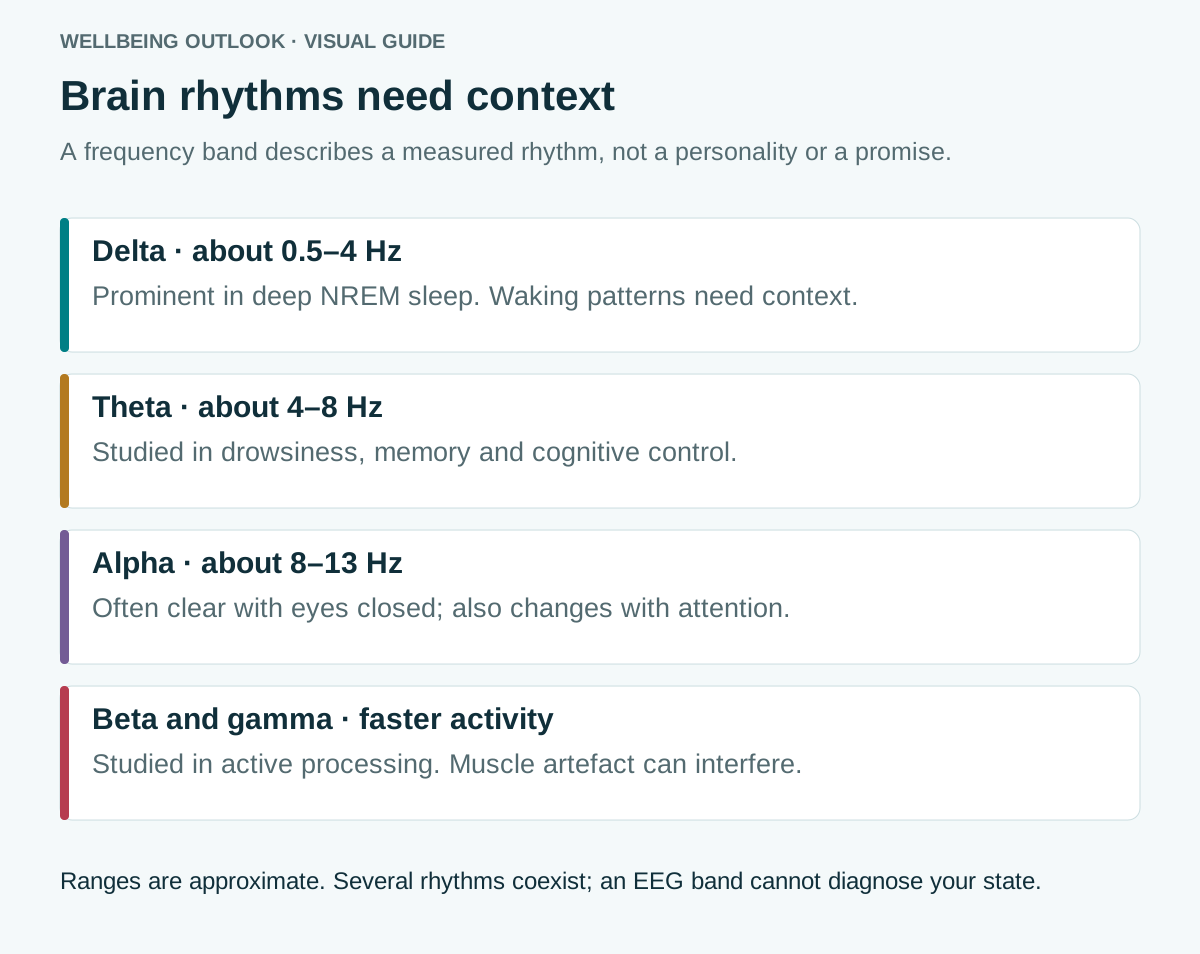
Delta commonly refers to activity around 0.5–4 Hz. In healthy adults it becomes prominent during deep sleep. Slow activity can also appear in other circumstances, and persistent delta during alert wakefulness may have clinical significance—one reason a consumer chart should never be used to interpret symptoms or self-diagnose.
Delta is sometimes marketed as “intuition,” “healing” or access to an unconscious radar. Those are evocative metaphors, not established meanings of an EEG band. A safer conclusion is simple: slow-wave activity is an important feature of sleep physiology, while its significance in waking recordings depends heavily on context.
Theta: drowsiness, memory and context
Theta is usually placed around 4–8 Hz. It becomes more visible as adults grow drowsy and enter early sleep. Theta activity also appears in research on memory and cognitive control, but the relationship is not “more theta equals better memory.” It varies by brain region, task phase and the individual’s baseline rhythm.
You may notice a subjective counterpart when attention turns inward, imagery becomes looser or you hover near sleep. That lived experience can be useful when building a wind-down routine. It still does not mean every creative insight or buried memory is caused by theta.
Alpha: quiet wakefulness—and active filtering
Alpha, roughly 8–13 Hz, is the best-known human EEG rhythm. It is often strong over posterior regions when an awake adult rests with eyes closed and typically reduces when the eyes open. For decades alpha was described as the brain “idling.” Current research paints a richer picture: alpha changes are involved in attention and in prioritising or suppressing information.
This explains why “alpha equals relaxation” is incomplete. Relaxed eyes-closed wakefulness often contains visible alpha, yet alpha also changes during demanding cognitive tasks. Its function depends on where and when it occurs. Producing more alpha is therefore not a universal goal.
Beta: active processing, not a stress meter
Beta generally covers activity above 13 Hz up to about 30 Hz. It is common during alert wakefulness and active mental or sensorimotor processing. A racing mind may feel “high beta” in wellness language, but an anxious thought cannot be identified from a frequency label alone. Muscle tension can also contaminate the higher-frequency portion of scalp recordings.
Beta is essential, not the enemy. Planning, responding and sustained engagement all require active networks. The practical question is whether alertness is proportionate to the moment—and whether you can disengage afterward.
Gamma: fast coordination, not instant genius
Gamma often refers to activity above 30 Hz. It has been studied in perception, attention and the coordination of information across neural populations. It is also technically difficult to measure cleanly at the scalp because tiny muscle movements can produce fast electrical signals. Claims that a particular gamma track automatically creates exceptional cognition or spiritual insight go beyond the evidence.
What a “state of mind” really means
A mental state emerges from interacting systems: neural activity, body arousal, breathing, hormones, sensory input, expectations and the situation around you. EEG provides one window into that process. It does not read thoughts, reveal a hidden personality or measure consciousness on a single ladder.
This matters because popular brainwave diagrams often turn associations into identities:
- Association: alpha is often prominent during relaxed, eyes-closed wakefulness.
- Overclaim: any 10 Hz sound places the entire brain in a deep-relaxation state.
- Association: theta changes occur during drowsiness and some memory tasks.
- Overclaim: theta automatically unlocks suppressed memories or creativity.
The first statements are grounded descriptions. The second statements promise a predictable causal effect that research has not established.
Why the “left-brain/right-brain” story also falls short
Some functions are lateralised: language or spatial processing may rely more strongly on one side in particular circumstances. But healthy thinking depends on networks that communicate across both hemispheres. People are not usefully divided into logical “left-brained” and creative “right-brained” types.
The same caution improves brainwave conversations. Creativity, calm and focus are network-level experiences, not the product of one hemisphere or one frequency operating alone.
A better target: state flexibility
The most compelling idea in older “awake mind” models was not that one wave is superior. It was that effective functioning involves access to different modes without becoming stuck in any of them. Modern language would call this flexible regulation rather than a perfect brainwave pattern.
You can explore that principle without an EEG:
- Name the task. Do you need sharp outward attention, imaginative exploration, physical recovery or sleep?
- Reduce competing signals. Close unnecessary tabs, lower environmental noise and set a clear session boundary.
- Choose a cue. That might be silence, slow breathing, music or a structured audio session.
- Observe function, not mythology. Are you calmer, clearer or sleepier? Can you stop comfortably? Does the effect carry into the next activity?
- Repeat under similar conditions. One striking session is an experience, not proof. A pattern across several sessions is more informative.
Where sound-based practice fits
Rhythmic audio can shape attention and subjective arousal, and auditory beat stimulation has been studied for anxiety, pain and cognition. The results are promising in some settings and mixed in others. Listening is best understood as a supportive condition—a cue that may make a desired state easier to approach—not a remote control for the brain.
A responsible session starts at a comfortable volume, in a safe place, with a realistic intention. The outcome to notice is not “Did I manufacture alpha?” but “Was it easier to settle, focus or transition?”
Frequently asked questions
Can I feel which brainwave band I am in?
You can recognise experiences such as alertness, drowsiness or inward attention, but you cannot reliably identify an EEG frequency by feeling alone. Measurement requires suitable equipment and careful interpretation.
Is alpha the ideal state?
No. Alpha is one prominent rhythm with several context-dependent functions. Active problem-solving, movement, rest and sleep involve different changing patterns.
Can music change brain activity?
Yes, sound can evoke measurable neural responses and alter attention or arousal. That does not mean a labelled frequency guarantees one precise emotional or clinical outcome.