Cognitive Load: Why Small Decisions Can Feel Exhausting
Small decisions become difficult when tasks, interruptions, uncertainty and emotion compete for limited working memory. Reduce avoidable load without treating willpower like a battery.
 Maya ChenMind & Brain editor5 September 2026
Mind & Brain · Explainer
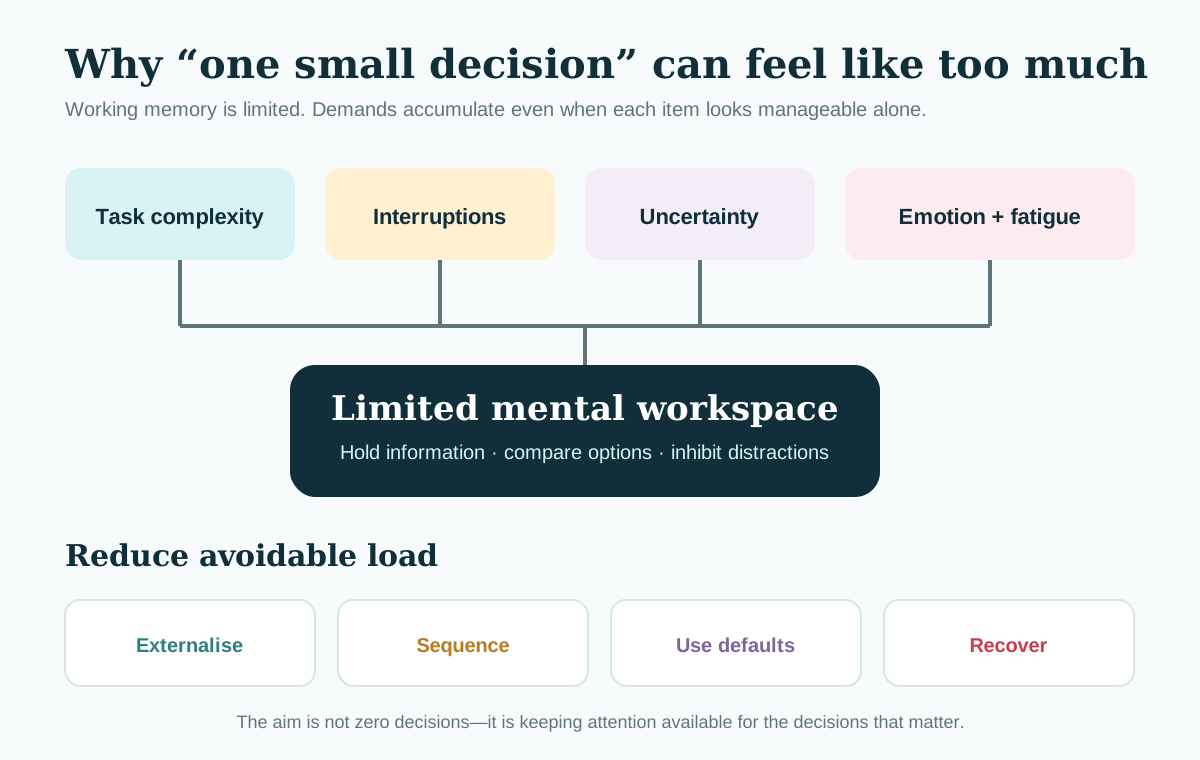
A small decision can feel exhausting when it lands on top of unfinished tasks, interruptions, uncertainty and emotion. The useful target is not eliminating choice; it is reducing avoidable demand on a limited mental workspace.

In short
- Working memory can hold and manipulate only a limited amount of information at once.
- Interruptions, unclear priorities and switching rules consume capacity even when no single task is difficult.
- “Decision fatigue” is a useful everyday description, but the idea of one depletable self-control resource is scientifically disputed.
- Externalising, sequencing, using reversible defaults and protecting recovery can reduce needless load.
Working memory is a workspace, not a warehouse
Working memory keeps information temporarily available while you use it: remembering a number long enough to type it, comparing two options or following the next step of a recipe. Its capacity is limited, especially when information is unfamiliar or attention is divided. Long-term knowledge can reduce the burden by grouping many details into meaningful chunks.
Cognitive load theory often distinguishes demand inherent to the material from demand created by presentation and from effort devoted to learning. Outside a classroom, the categories blur, but the principle travels well: a complex task, a confusing system and the need to learn a new rule can all compete for the same attention.
Why small choices become the breaking point
Imagine choosing dinner while holding an unfinished work problem in mind, monitoring messages, anticipating a difficult conversation and trying to remember what is already in the fridge. Dinner is not objectively a high-stakes decision. It is simply the next item asking for comparison and commitment.
Uncertainty increases the work: Which criteria matter? Can the choice be reversed? Who will be affected? Emotional stakes can narrow attention or make error feel costly. Sleep loss, pain, hunger and sustained stress may further reduce effective performance. “I cannot decide” can therefore mean “the decision has not been structured.”
Decision fatigue is not a drained battery
Popular accounts describe self-control as a fuel that runs out. Evidence for that simple “ego depletion” model is weak. A preregistered replication across 23 laboratories and 2,141 participants found an effect close to zero for a standard sequential-task test. That does not mean fatigue or overload is imaginary; it means one universal depleted resource is not a sufficient explanation.
Research in clinical decision-making also finds inconsistent definitions and mostly indirect measurement of decision fatigue. Time of day can be confounded with workload, case mix, breaks and organisational routines. Use the phrase to describe an experience, not to diagnose a fixed brain state.
Four ways to reduce avoidable demand
Externalise
Move information out of working memory: write the next action, keep one trusted list, lay out the ingredients or use a checklist for repeated high-risk work. The tool should reduce remembering, not become another system to maintain.
Sequence
Ask “What decision unlocks the next ten minutes?” Separate choosing from doing. Closing irrelevant tabs and pausing notifications reduces the cost of reconstructing context after each interruption.
Use defaults for reversible choices
A regular breakfast, shopping list or meeting template can prevent ordinary choices from competing with consequential ones. Keep defaults easy to override; rigidity creates a new burden when circumstances change.
Recover and change the environment
Food, sleep, movement and a genuine break can help when capacity is low, but personal recovery cannot repair an impossible workload. Fewer approvals, clearer ownership and longer uninterrupted blocks may be the more important intervention.
A five-minute decision reset
- Write the decision in one sentence.
- Name two or three criteria rather than comparing everything.
- Decide whether the choice is reversible. If it is, choose a good-enough option and set a review point.
- If it is not reversible, identify what information is genuinely missing.
- Record the next action so the decision does not remain mentally open.
Persistent difficulty concentrating, a sudden change in cognition or impairment across daily life can have medical or mental-health causes. Seek assessment rather than assuming you need a better productivity system.
Sources and further reading
- Hagger et al. (2016): Multilab preregistered replication of ego depletion
- Grignoli et al. (2025): Clinical decision fatigue—systematic and scoping review
- Buschman (2021): Flexibility, interference and working-memory capacity
- van Merriënboer and Sweller (2010): Cognitive load theory—principles and strategies