When a Concert Audience Moves in Sync: Rhythm and Social Connection
Concert audiences can align movement, physiology and some EEG patterns around shared musical structure. What synchrony measures—and why it is not mind fusion.
 Jonas ReedCalm Signal editor5 September 2026
Calm Signal · Study digest
Concert audiences can align their movement, physiology and some EEG patterns around shared musical structure. These forms of synchrony are measurable and intriguing—but they are not interchangeable, and none demonstrates mind fusion.
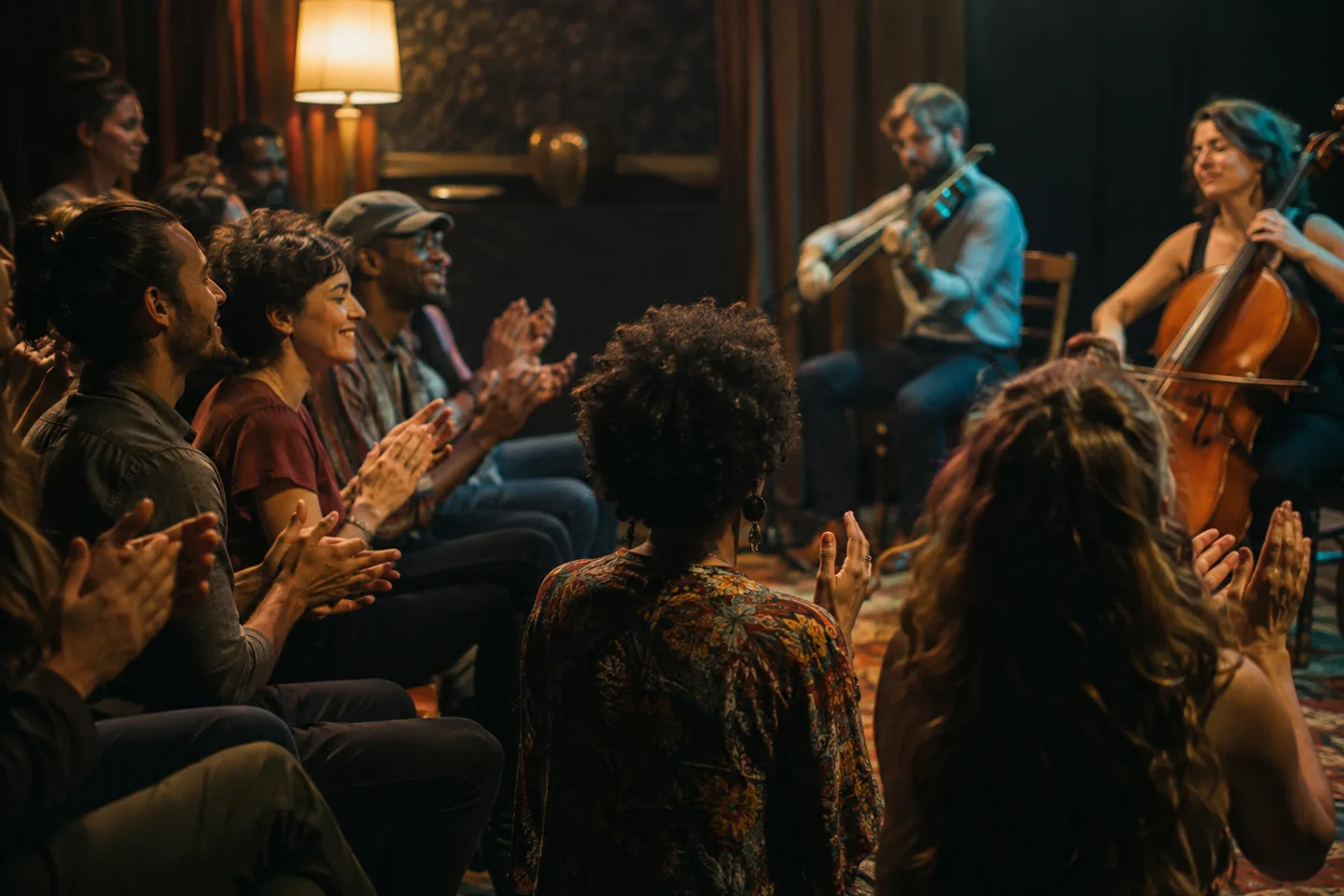
In short
- “Audience synchrony” may refer to aligned movement, body signals or electrical brain patterns.
- Shared sound and visible social cues can produce alignment without direct person-to-person transmission.
- Small real-world studies link synchrony with musical structure, tempo, familiarity, attention and social context.
- Synchrony is not automatically bonding, empathy, health improvement or telepathy.
First ask: what was synchronised?
When people say a crowd was “on the same wavelength,” they may mean something visible: clapping, swaying or stepping together. Researchers can also compare heart rate, breathing or skin conductance, or record scalp electrical activity with EEG. Each measure captures a different process and needs a different interpretation.
Two signals can rise and fall together because people hear the same beat, watch the same performers, share a room or respond to one another. The correlation is real without implying that one brain transmits thoughts to another. A common stimulus is not a nuisance to erase; in a concert it is part of the mechanism that organises collective attention and action.
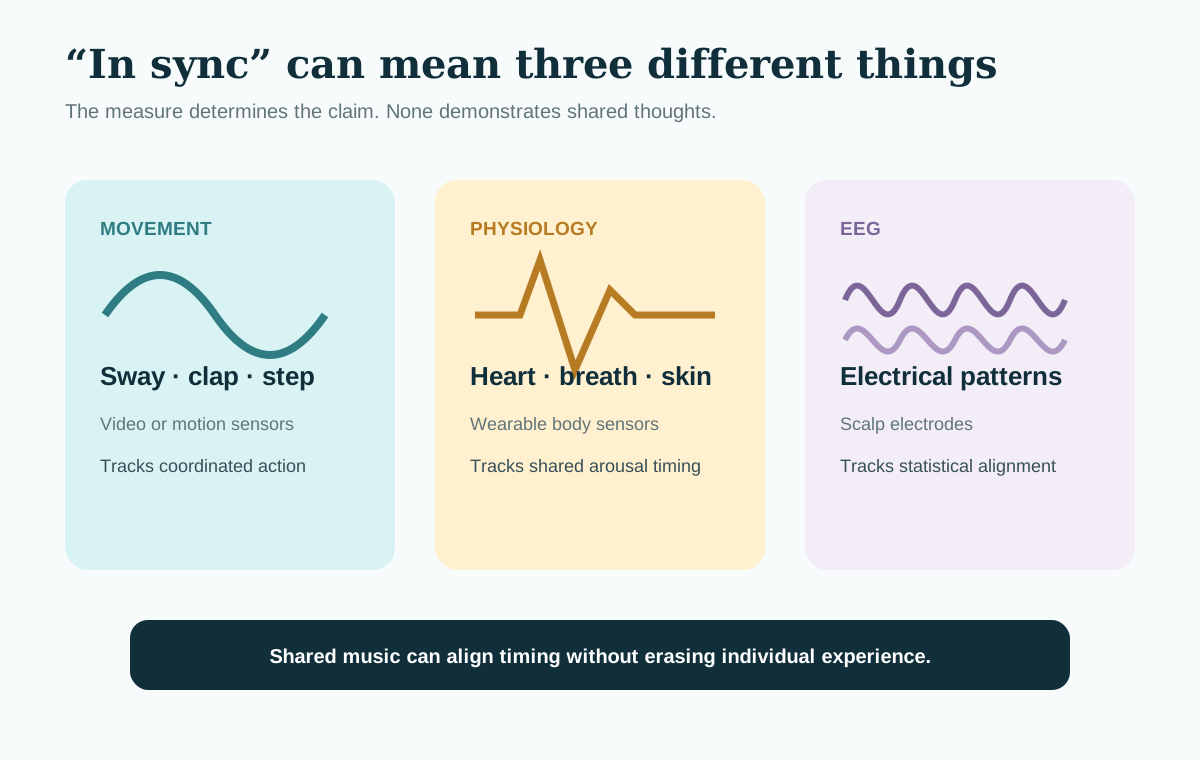
A quartet, four listeners and a very small EEG network
One exploratory study recorded EEG from a guitar quartet and four audience members during a live concert—eight participants in total. The researchers analysed within-brain and between-brain connectivity in different frequency bands during music and applause. Delta-band network organisation differed between musicians and listeners and between performance and applause periods.
This was an unusual real-world hyperscanning demonstration, not a population estimate. With four performers and four listeners, individual movement, muscle activity, recording noise and the exact programme can strongly influence results. EEG “connectivity” here is a mathematical relationship between recorded signals; it does not reveal matching thoughts or prove that listeners became emotionally bonded.
What larger audience studies add
Other concert research has used less invasive measures across more people. In audiences attending live string-quintet performances, physiological alignment appeared around structural moments in the music and varied with tempo and familiarity. A club study using motion capture found that torso-movement synchrony was associated with tempo in roughly the 100–150 beats-per-minute range and with song popularity.
Research in classical concert settings has also linked some physiological synchrony with self-reported attention and shared experience. These associations help generate hypotheses about collective engagement, but they do not show that synchrony caused enjoyment or connection. People who are more attentive may simply respond more consistently to the same musical events.
Three routes to moving together
| Route | Example | What it does not prove |
|---|---|---|
| Common stimulus | A strong beat prompts many listeners to sway at the same moments. | That listeners communicate directly with one another. |
| Mutual perception | People see nearby bodies move and adjust their own timing. | That alignment is conscious or emotionally positive. |
| Shared convention | An audience recognises when to clap or become quiet. | That every person has the same experience. |
Does synchrony create social connection?
Laboratory studies of coordinated movement often report effects on affiliation, cooperation or perceived closeness. Concerts add richer variables: music preference, identity, expectations, crowd density, alcohol, acoustics and performer–audience feedback. Synchrony may contribute to connection, signal it, or simply accompany a moment that produces both.
The direction can also be uncomfortable. A crowd may coordinate under social pressure, and physiological alignment can reflect tension as well as pleasure. More synchrony is not universally better. Meaning depends on what is synchronised, why, for how long and how participants describe the experience.
What this means for everyday listening
You do not need an EEG headset to use rhythm socially. Walking to music, singing with others, dancing or gently clapping can make timing easier to share. Keep the activity optional and accessible: some people prefer stillness, quieter spaces or ear protection, and their lack of visible movement does not imply disengagement.
Protect hearing at amplified events by taking quiet breaks, increasing distance from speakers and using well-fitted earplugs. Leave or seek help for pain, sudden hearing change, marked dizziness or distress. Scientific language about synchrony should never be used to market unsafe sound levels or promise neurological healing.
Sources and further reading
- Intra- and interbrain synchrony in a guitarist quartet and audience during a concert
- Audience physiological synchrony during live string-quintet performances
- Music features and audience movement synchrony in a club setting
- Physiological audience synchrony and concert experience
- World Health Organization: Safe listening