Flexibility and Mobility Are Not the Same Thing
Available range and controlled usable range overlap but are not identical, and both stretching and strength work can improve movement capacity.
 Priya ShahMovement & Mobility editor5 September 2026
Movement & Mobility · Comparison
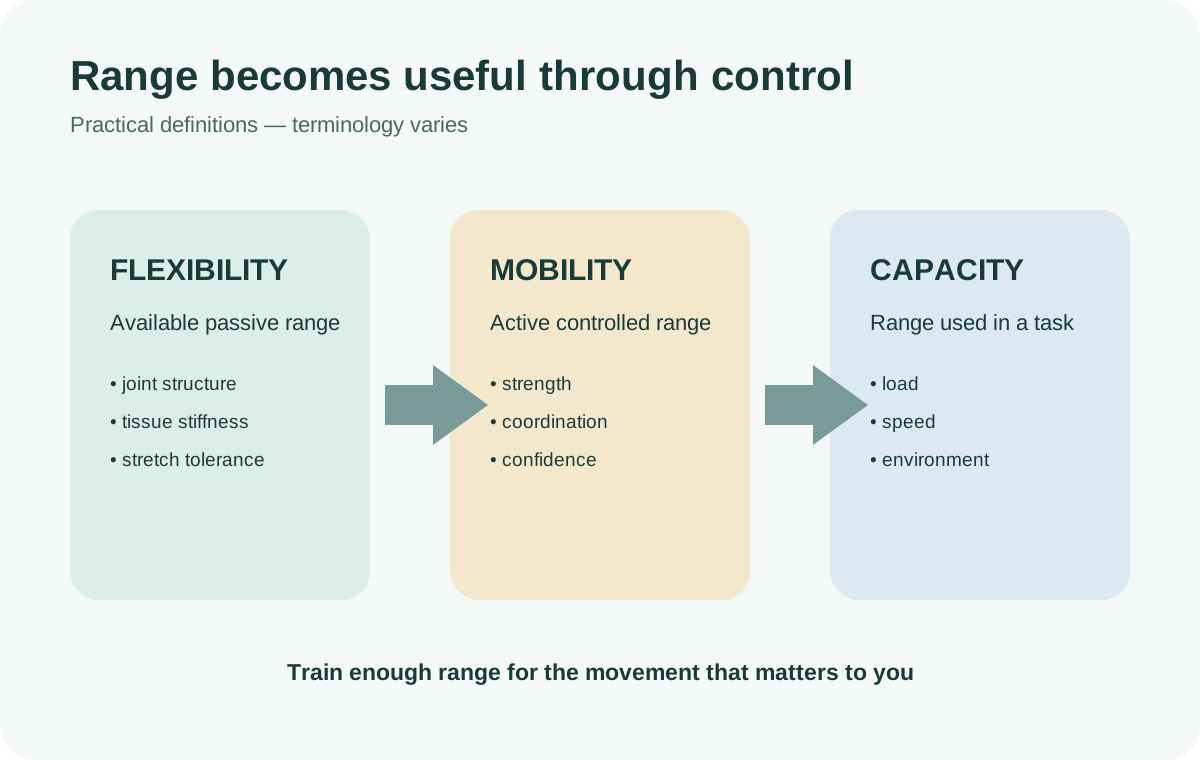
Flexibility describes available range; mobility usually describes how well you can use and control it. The terms overlap, but the distinction can make training more purposeful.
In short
- Flexibility is commonly used for passive joint or muscle range.
- Mobility is a coaching term for active, controlled and task-usable range.
- These are practical definitions, not a universal medical taxonomy.
- Stretching and strength training can both improve range of motion.
Two terms, one useful question
Can your body reach a position, and can it control that position under the demands that matter? A clinician may measure passive hip range while another person moves the limb. A coach may observe whether you can actively enter a lunge, keep balance and produce force. The first view emphasises available range; the second emphasises usable movement.
In research, “mobility” can also mean walking ability or general functional independence. Definitions must therefore be stated rather than assumed. Online claims that flexibility and mobility are completely separate biological qualities oversimplify the language.
Why passive and active range can differ
A joint may be moved farther by gravity, a strap or a practitioner than you can move it using your own muscles. Active range depends on strength at the edge, motor control, balance, pain, threat perception and familiarity. Passive range also depends on joint structure, tissue stiffness and stretch tolerance.
A gap between active and passive range is not automatically a defect. It becomes relevant when it limits a valued activity, reflects injury or creates instability. Some people need more range; others need confidence and strength in the range they already have.
What stretching changes
Regular stretching can improve joint range of motion. Changes may include greater stretch tolerance and modest changes in mechanical stiffness; the mechanism varies with duration and programme. Aggressive pain is not required. A sensation of tension is different from sharp, electrical or joint pain.
Long static stretching immediately before maximal sprinting or lifting can transiently reduce performance in some contexts, especially at larger doses. That does not make static stretching harmful. Place longer holds after training or in a separate session when peak power is the priority.
What strength training changes
Strength exercise through a comfortable full range can also improve range of motion. A systematic review comparing resistance training with stretching found no clear difference in ROM gains, although studies were heterogeneous. Loaded movement adds force production and control, which can make new range more usable.
This does not mean every loaded exercise is appropriate. Technique, load, speed and symptoms matter. Start with a range you can own, then expand it gradually.
A four-part mobility session
- Explore: move the joint slowly through a comfortable range for five repetitions.
- Pause: use a gentle 20- to 30-second stretch where restriction is felt.
- Control: lift into the range without assistance, using a reduced arc if needed.
- Integrate: practise a relevant pattern such as a squat to a chair, step-down or overhead reach.
Two or three targeted movements done consistently usually beat a catalogue of random drills.
Choose the limitation, not the trend
If the heel rises in a squat, ankle range may be one factor, but proportions, stance, footwear, strength and the task goal also matter. If an overhead reach is limited, the shoulder, ribcage and upper back can all contribute. A screen is a starting observation, not a diagnosis.
Compare sides, note pain and retest after one simple intervention. An immediate change can guide practice, but it does not identify tissue damage or prove a permanent correction.
When more range is not the goal
Dancers and gymnasts may need large ranges; many daily tasks do not. People with joint hypermobility can feel tight because muscles work hard to stabilise them. Repeatedly stretching farther may worsen symptoms, whereas paced strength, balance and load management may help.
Seek assessment for a sudden loss of motion, swelling, locking, instability, numbness, progressive weakness or pain after trauma. Avoid forcing a joint through a hard or painful block.
Measure what matters
Use a task you care about: reaching a shelf, tying shoes, turning to reverse a car or descending stairs. Record comfort and control as well as distance. Improvement is a movement that becomes easier and more reliable, not simply a deeper pose for a photograph.