From Pythagoras to Playlists: A Brief History of Sound and Harmony
A measured string, tuning fork, recording groove and digital file trace how harmony became portable—without turning musical ratios into universal medicine.
 Jonas ReedCalm Signal editor5 September 2026
Calm Signal · History feature
From a divided string to a streamed catalogue, the history of harmony is a history of measurement, cultural choice and technology. Its mathematics are powerful—without proving that particular ratios universally heal.

In short
- Ancient Greek traditions connected consonant intervals with simple numerical ratios, often demonstrated on a monochord.
- The famous story of Pythagoras discovering harmony from hammer weights is a late legend and its physics does not work as told.
- Tuning systems are practical compromises shaped by instruments, repertoire and culture.
- Modern acoustics and recording made sound measurable and repeatable; they did not validate “sacred frequency” health claims.
The divided string
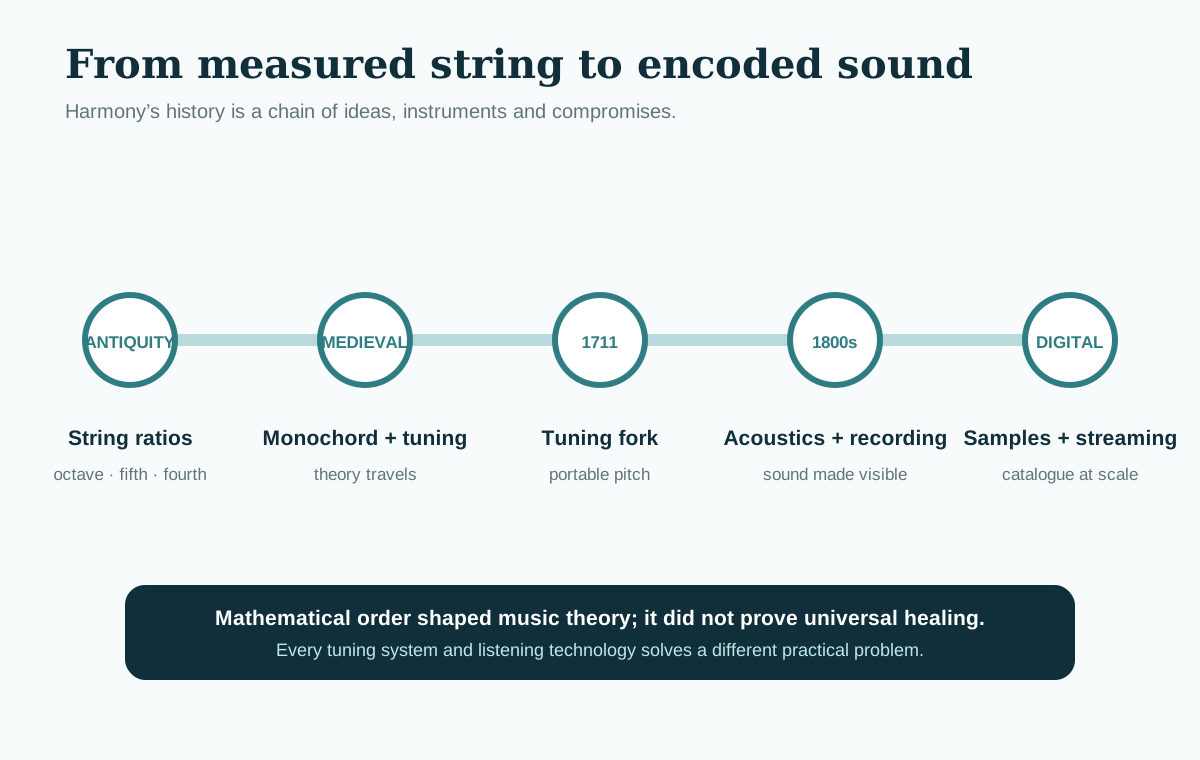
A monochord is a single stretched string with a movable bridge. Divide the vibrating length by simple proportions and the pitch changes predictably: a 2:1 frequency ratio gives an octave; 3:2 gives a fifth; 4:3 gives a fourth. Traditions associated with Pythagoras and later Pythagoreans made such relationships central to Western accounts of music and number.
Pythagoras left no surviving writings, and later sources mixed demonstration, philosophy and legend. The tale in which he hears harmonious blacksmiths’ hammers and discovers intervals from their weights is memorable but physically incorrect: pitch does not follow hammer weight in the simple ratios claimed. The monochord is the more credible teaching instrument.
Harmony was never only mathematics
Simple ratios describe important acoustic relationships, but musical systems select, tune and use them differently. Stack pure fifths and the cycle does not close perfectly with a sequence of octaves; the small mismatch is called the Pythagorean comma. Instrument makers and musicians developed temperaments that distribute tuning discrepancies in different ways.
Equal temperament, now common for keyboards and much global commercial music, divides the octave into twelve equal logarithmic steps. Its fifths and thirds are not all acoustically pure ratios. The compromise allows modulation between keys with consistent interval structure. Other musical cultures use different scales, intonations and concepts of consonance. There is no culture-free “perfect” playlist encoded by nature.
Standards made ensembles portable
A tuning fork is an acoustic resonator that produces a relatively stable pitch. Its invention is generally credited to English musician John Shore in 1711. Forks provided portable reference tones for instruments and later laboratories, although pitch standards still varied between places and periods.
Standardisation helped larger ensembles, manufacturing and broadcasting coordinate. It was an agreement for interoperability, not discovery of a biologically privileged frequency. Today’s common A above middle C at 440 Hz is a convention with historical alternatives, not a universal healing constant.
Acoustics separates source, signal and perception
Nineteenth-century researchers developed instruments and theories for visualising vibration, analysing partials and connecting physical sound with auditory perception. Hermann von Helmholtz’s work on tone sensation became influential in explaining timbre and consonance through components of complex sounds and the physiology of hearing.
A Chladni plate or modern cymatics demonstration can make standing-wave patterns visible in sand or liquid. The geometry depends on the plate, boundary conditions, material, driving point, amplitude and frequency. A beautiful pattern demonstrates resonance in that apparatus; it does not show that the same frequency reorganises or heals human organs.
Recording uncoupled sound from the moment
Mechanical recording in the nineteenth century allowed sound to be captured and replayed. The phonograph, publicly demonstrated by Thomas Edison in 1877, inscribed vibration into a physical groove. Discs, microphones, electrical amplification, magnetic tape and vinyl successively expanded fidelity, editing and distribution.
Digital audio samples a signal and represents amplitude with numbers. Compression and streaming then made enormous catalogues instantly accessible. Each format shapes listening through bandwidth, dynamics, interfaces, economics and recommendation systems. The history of sound is also a history of who gets recorded, credited, paid and heard.
What survived into playlists
| Historical idea | What remains useful | What needs caution |
|---|---|---|
| String ratios | Clear relationship between physical dimensions and musical interval. | Simple ratios are not automatically more therapeutic. |
| Music of the spheres | A powerful philosophical metaphor linking cosmos and order. | Celestial “harmony” was not an audible scientific measurement. |
| Resonance | A measurable response of a system to driving frequency. | It does not imply selective organ healing from an online tone. |
| Standard pitch | Lets instruments coordinate reliably. | A convention is not a health mechanism. |
Music can matter without sacred arithmetic
Music can support pleasure, memory, movement, identity, emotion regulation and social connection. Clinical music interventions are studied for defined populations and outcomes. Their effects may involve expectation, attention, relationship, rhythm and meaning rather than a single numerical frequency.
Enjoy historical symbolism as symbolism. For health claims, ask for the actual exposure, dose, comparison, outcome and safety data. Mathematics gives music structure; evidence determines whether an intervention helps.