How to Read a Health Article Without Getting Misled
A practical six-question method for turning a health headline back into the study it came from: design, absolute effects, uncertainty, comparison and fit.
 Claire DupontEveryday Health editor5 September 2026
Everyday Health · Evidence guide
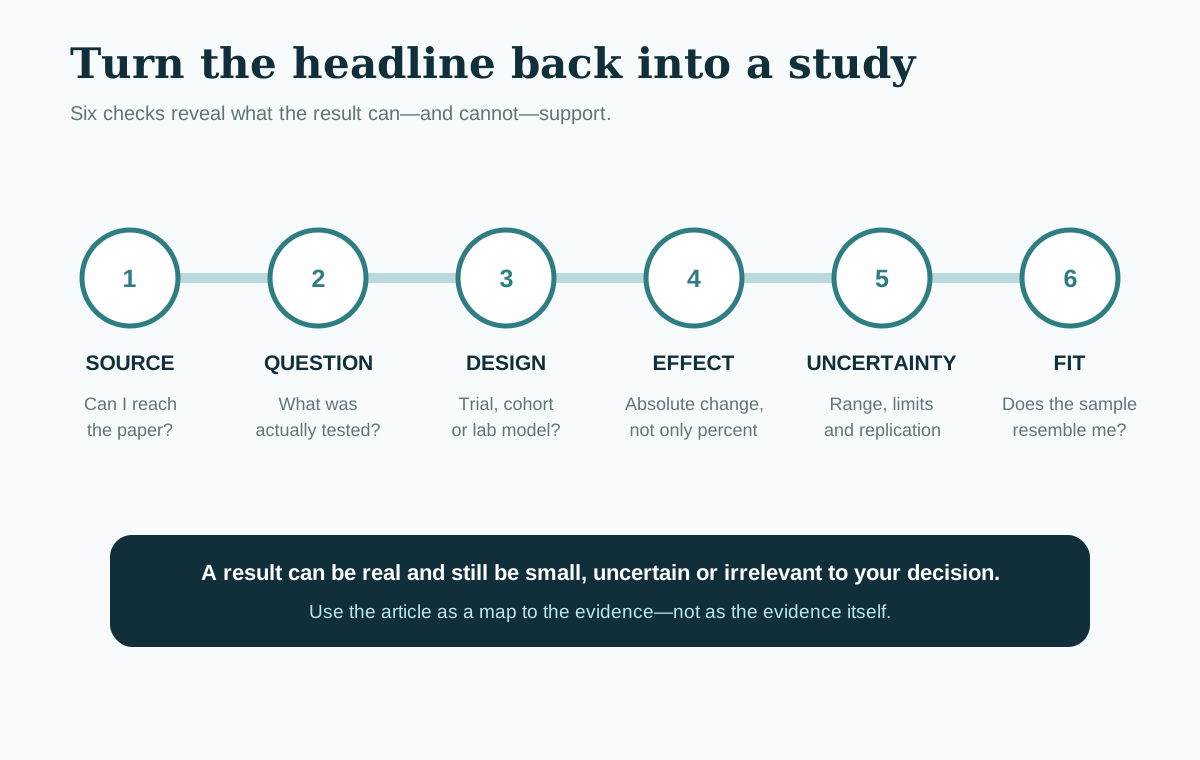
A health headline is an invitation, not a verdict. Six practical questions can turn it back into the study it came from—and show whether the result is causal, meaningful and relevant to you.

In short
- Find the original study before judging the article’s conclusion.
- Match causal language to the design: an association is not automatically an effect.
- Look for absolute numbers, the comparison group and uncertainty—not only a relative percentage.
- Ask who was studied, what outcome was measured and whether the result changes a real decision.
1. Can you reach the source?
A trustworthy news article should name the journal, researchers or institution and ideally link to the paper. Follow that trail. A press release, conference abstract and peer-reviewed article are different stages of evidence. If the only source is another article, a product page or an unnamed “study,” the claim is difficult to check.
On the paper’s first page, identify the publication date, population, study design and primary outcome. An abstract is compressed and can omit important limitations, but it is still closer to the methods and results than a headline. Check corrections or retractions when the decision is consequential.
2. What question did the researchers actually ask?
Translate the headline into a plain research question: who received or experienced what, compared with whom, for how long, and what changed? “Coffee improves longevity” might turn out to mean that adults who reported moderate coffee intake had a lower death rate during follow-up. That is useful information, but it is not the same as randomly assigning coffee and proving it extended life.
Also distinguish a surrogate from an outcome people directly feel. A change in a blood marker, scan or questionnaire may be informative without proving fewer heart attacks, better daily function or longer life. Animal, cell and laboratory studies can explain mechanisms and generate hypotheses; they do not establish that the same benefit occurs in humans at a safe dose.
3. Does the wording fit the design?
| Design | What it can usually tell you | Common overreach |
|---|---|---|
| Randomised trial | Whether assigning an intervention changed outcomes under study conditions | Assuming one trial proves benefit for everyone or reveals long-term safety |
| Observational cohort | Whether an exposure and outcome travel together over time | Turning “associated with” into “causes” |
| Cross-sectional survey | What variables coexist at one point in time | Claiming which one came first |
| Systematic review | What a defined body of studies collectively reports | Ignoring weak, inconsistent or heterogeneous underlying studies |
Randomisation reduces some alternative explanations, but it does not make a study flawless. Attrition, selective outcomes, small samples, short follow-up and poor blinding can still matter. Observational evidence can be strong and important, especially for harms or long-term exposures, but causal language needs additional support.
4. How large is the effect in real numbers?
Relative changes often sound dramatic. If an outcome falls from 2 people in 1,000 to 1 in 1,000, that is a 50% relative reduction and a 0.1 percentage-point absolute reduction. Both are mathematically correct; the absolute figures tell you more about the likely personal impact. Ask for event counts, baseline risk and the time period.
Statistical significance does not answer whether an effect is large enough to matter. A confidence interval shows a range of values compatible with the data under the model. A wide interval signals imprecision; an interval can include effects that are helpful, trivial or harmful. Exact thresholds should not replace judgment about magnitude, uncertainty and measurement quality.
5. What might change the interpretation?
Read the limitations section, then add your own questions. Was the result one of many analyses? Was the study preregistered? How many people left? Were outcomes self-reported? Who funded the work, and did investigators report conflicts? Funding does not automatically invalidate a study, but transparency helps readers assess choices in design, analysis and reporting.
Replication matters because chance findings, flexible analyses and context-specific effects can look persuasive once. Compare the result with a recent systematic review or evidence-based guideline when available. Reporting checklists such as CONSORT for randomised trials, STROBE for observational research and PRISMA for systematic reviews help authors disclose essential information; they are reporting tools, not automatic quality stamps.
6. Does the evidence fit this person and this decision?
Age, health conditions, medications, baseline risk, setting and preferences affect applicability. A statistically average effect may not predict one individual’s outcome. The practical question is not simply “Is this true?” but “How much confidence should this evidence carry in this choice, compared with the risks, costs and alternatives?”
For a low-risk habit, uncertainty may be acceptable. For stopping medication, delaying assessment, buying an expensive device or treating a serious condition, require stronger evidence and discuss it with a qualified clinician who knows the full context. Urgent symptoms should never wait for online research.
A two-minute reading routine
- Open the original source and name the design.
- Rewrite the headline as the exact question studied.
- Find the comparison, absolute numbers and follow-up time.
- Read the limitations and conflicts.
- Decide whether the outcome and population match your decision.
- Keep uncertainty visible: promising is not proven, and statistically detectable is not necessarily important.
Sources and further reading
- MedlinePlus, US National Library of Medicine: Evaluating health information
- EQUATOR Network: Reporting guidelines for major study designs
- Claims of causality in health news: a randomised trial
- Interpretation of intervention studies in online health news
- Interpretation of correlations in clinical research