Journalling for Stress: Prompts Without Pressure
Short, purposeful journalling can unload, clarify or plan without becoming a daily performance or a new form of rumination.
 Daniel OkaforStress & Emotional Health editor5 September 2026
Stress & Emotional Health · Practical guide
Journalling can create distance, organise a decision or preserve one honest observation. It does not need to be daily, beautiful or emotionally intense to be useful.

In short
- Choose a purpose: unload, clarify, plan, notice or communicate.
- Use short timed prompts and stop before writing becomes rumination.
- Protect privacy and do not force trauma disclosure.
- Research suggests small average benefits, with substantial individual variation.
What writing can do
Writing externalises material that working memory is trying to hold. It can turn a vague threat into parts, distinguish facts from predictions and reveal one next action. It can also preserve moments of competence or connection that stress makes easy to overlook.
Expressive-writing studies show mixed results. A recent meta-analysis found a small delayed benefit for depression, anxiety and stress symptoms in healthy and subclinical groups; an earlier review found minor or no overall health effects. Journalling is a tool, not a treatment guarantee.
Start with a container
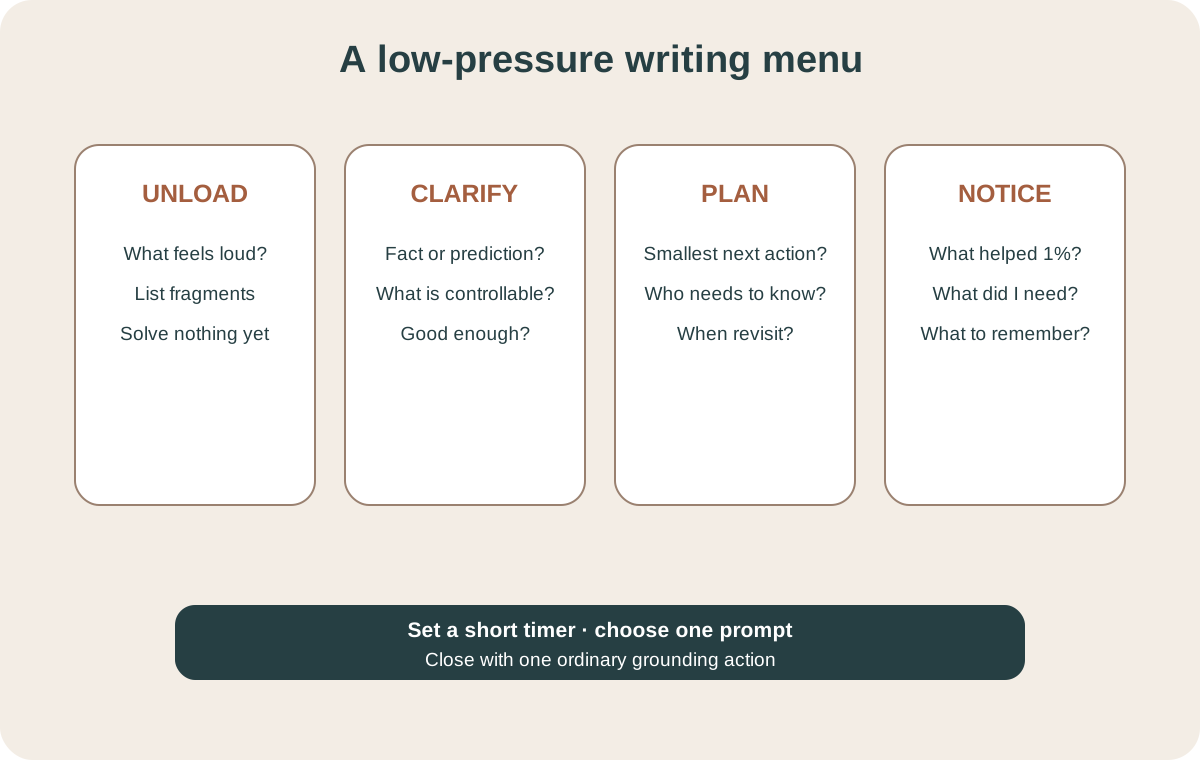
Set a timer for three to ten minutes. Choose paper, a notes app or voice-to-text according to privacy and accessibility. Begin with one sentence and stop when the timer ends. You can continue by choice, not obligation.
Close with a grounding action: stretch, wash the cup, step outside or name the next ordinary task. This signals that reflection has an edge.
Prompts for unloading
- What is my mind trying not to forget?
- What feels loudest right now?
- If I could put one concern down until tomorrow, which one?
- What belongs to me, and what belongs to someone else?
Do not solve while unloading. List fragments. Then circle at most one item that needs action.
Prompts for clarity
- What happened, and what am I predicting?
- What evidence supports my interpretation? What complicates it?
- Which part is controllable in the next 24 hours?
- What would “good enough” look like?
Use plain language. Elegant insight is not required.
Prompts for planning
- What is the smallest next visible action?
- Who needs to know, and what do I need to ask?
- What can be postponed, delegated or removed?
- When will I revisit this decision?
A plan should reduce cognitive load. If the list grows without priority, choose one action and one boundary.
Prompts for noticing
- What helped by one percent today?
- Where did I feel most like myself?
- What did my body need?
- What ordinary thing deserves to be remembered?
This is not forced gratitude. Difficult and good details can coexist.
When writing becomes rumination
Warning signs include repeating the same accusation, escalating certainty, losing sleep to writing or feeling more activated each time. Change format: use bullet points, a fact-versus-story table, a strict timer or a next-action prompt. Sometimes movement, conversation or sleep is the better tool.
If writing about trauma produces flashbacks, dissociation or intense distress, stop. Trauma processing is not a self-imposed endurance test; qualified support can provide pacing and safety.
Privacy and relationships
Decide where entries live, who can access them and whether they should be deleted. Shared devices and cloud backups change privacy. A journal is not automatically the best place for information that must reach a clinician, employer or loved one.
If the real task is a conversation, use writing to draft three points, then communicate them.
A seven-day low-pressure trial
On three nonconsecutive days, write for five minutes using one prompt. Before and after, rate tension from zero to ten and note whether you gained clarity or an action. At the end of the week, keep only what helped. Missing a day contains no information about character.