K-Complexes: The Sleep Waves That Help Protect Rest
A K-complex is a large EEG event that helps define N2 sleep and can appear after a sound without waking the sleeper. What it may reveal about sensory monitoring, sleep stability and memory.
 Elena MoralesSleep & Recovery editor5 September 2026
Sleep & Recovery · Sleep glossary
A K-complex is a large, brief EEG event characteristic of stage N2 sleep. It can appear spontaneously or after a sound, reflecting a sleeping brain that still registers the world without necessarily waking up.
In short
- K-complexes are large biphasic waves recorded at the scalp and are one of the features used to identify N2 sleep.
- They can occur on their own or in response to sensory events, especially sounds.
- A K-complex is not simply a protective shield: the same event may be followed by continued sleep, a spindle or an arousal.
- Laboratory findings about memory and sound stimulation are promising but do not justify consumer claims that an audio track can “program” K-complexes.
What is a K-complex?
On an EEG trace, a K-complex appears as a prominent negative wave followed by a positive component. Sleep scorers look for a well-delineated event lasting at least half a second, usually most visible over frontal regions. Along with sleep spindles, K-complexes help identify N2, the stage that occupies a substantial part of a typical adult night.
The name describes the waveform, not a sensation. You cannot reliably feel a K-complex, and having one is not the same as briefly waking. It is an observation made from electrical activity recorded with adequate scalp electrodes and interpreted in the context of the surrounding sleep trace.
What happens in the cortex
Intracranial recordings support the view that the major negative phase of a K-complex includes a widespread cortical down-state: many cortical neurons become briefly less active together. Activity then recovers. The event resembles part of the slow oscillation seen more continuously in deeper N3 sleep, although a K-complex is a distinct, isolated feature in N2 scoring.
This coordinated pause may help explain why K-complexes have been discussed in relation to both sleep stability and information processing. It can interrupt ongoing cortical activity while leaving the person asleep. That is a useful physiological description; assigning it one exclusive purpose is harder.
A sleeping brain is not disconnected
Names, tones, knocks and other sounds can evoke K-complexes. The response shows that sensory input reached and influenced the sleeping brain. Sometimes the sleeper remains in N2. Sometimes the event is followed by faster EEG activity, an arousal or awakening. Loudness, meaning, sleep depth and individual sensitivity all matter.
A small laboratory study of environmental noise found that noise-evoked K-complexes were a sensitive marker of sensory processing during sleep. The result fits a monitoring role, but it does not prove that every K-complex successfully “blocks” a disturbance. The brain’s response is better pictured as a fork in the road than a closed gate.
How nearby sleep events differ
| EEG event | Typical appearance | What it helps describe |
|---|---|---|
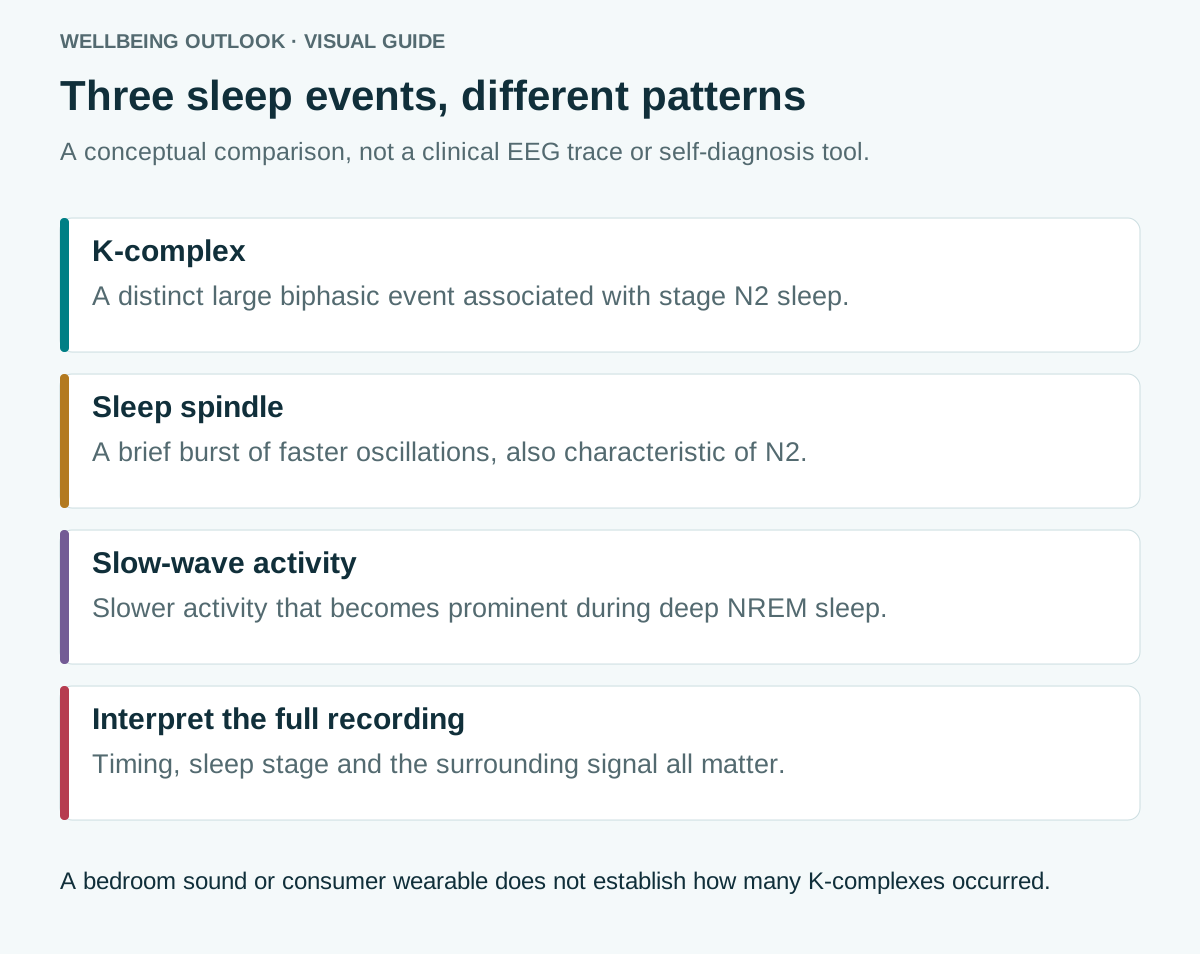
| K-complex | Large, isolated biphasic wave, often frontal | N2 sleep and a possible response to internal or external input |
| Sleep spindle | Brief waxing-and-waning burst around 11–16 Hz | N2 sleep; thalamocortical coordination and memory research |
| Slow wave | Repeated high-amplitude slow activity | N3 or deep sleep when sufficiently prevalent |
| Arousal | Abrupt shift toward faster EEG activity | A short activation that may fragment sleep without a remembered awakening |
These events interact. A K-complex can be followed by a spindle or an arousal, and its interpretation depends on what came before and after. A single cropped waveform cannot summarise the quality of a whole night.
Do K-complexes protect sleep?
The protective account is plausible: an external stimulus can be registered, a K-complex can occur and sleep can continue. Researchers have therefore proposed that the response helps the brain evaluate input while preserving sleep when awakening is unnecessary. Yet K-complexes are also associated with routes toward arousal, and their probability changes with sleep pressure and stimulus properties.
The most accurate phrasing is that K-complexes participate in the balance between monitoring and maintaining sleep. “Protection” is a functional hypothesis, not a guarantee attached to every wave. More K-complexes are not automatically better, especially if they are being repeatedly evoked by disruptive noise.
What about memory?
N2 sleep is involved in research on memory consolidation, especially through interactions among slow oscillations, spindles and hippocampal activity. In a 2024 study of 14 young adults, sounds timed during sleep produced a K-complex-like response followed by spindle activity; the combined response was associated with better verbal memory performance. The experiment offers a possible mechanism, not a home treatment.
The sample was small, the stimulation was delivered in a controlled closed-loop setup and the paper disclosed commercial ties to a sleep-technology company. Replication in larger and more diverse groups is needed before concluding that deliberately eliciting the response improves meaningful everyday memory.
Can an app or wearable count them?
Clinical sleep studies use multiple channels: scalp EEG, eye movements, muscle activity, breathing, oxygen and often heart rhythm. Some research and consumer devices estimate sleep stages with fewer sensors, but a wrist movement trace or optical pulse signal does not directly measure a K-complex. Even forehead EEG wearables have fewer channels and less controlled electrode contact than laboratory systems.
A device may provide a trend that is useful for routine, but a nightly “deep sleep” score should not be translated into a count of healthy cortical events. Algorithms, stage definitions and error rates differ, and consumer estimates are not a diagnosis.
Why ordinary bedtime audio is not closed-loop stimulation
Sleep laboratories can detect the ongoing EEG phase and deliver precisely timed, calibrated sounds. A playlist or fixed-frequency track usually does not know the listener’s current sleep stage, cortical phase, hearing threshold or response. It may be relaxing or mask disruptive background noise, but that experience is different from demonstrating a targeted K-complex or memory effect.
Be wary of products promising to produce K-complexes, “lock in” learning or guarantee deep sleep. A physiological term can make a marketing claim sound measured even when the relevant physiology was never recorded.
When the bigger sleep picture matters
K-complexes rarely need attention outside a sleep study. Repeated loud snoring, witnessed breathing pauses, gasping, severe daytime sleepiness, unusual night-time behaviours or persistent insomnia are reasons to discuss sleep with a clinician. The useful question is not “Am I making enough K-complexes?” but “Is my sleep opportunity adequate, is sleep being disrupted, and is daytime function affected?”
Sources and further reading
- American Academy of Sleep Medicine: Scoring manual update summary
- Cash et al. (2009): The human K-complex represents an isolated cortical down-state
- Colrain (2005): The K-complex—a 7-decade history
- Lechat et al. (2021): K-complexes and noise-related sensory processing
- Leach et al. (2024): K-complex-like responses, spindles and memory