Meditation and the Brain: What a Nine-Month Study Found
A nine-month longitudinal project linked attention, compassion and perspective training with different brain and behavioural changes. What the design found—and what it cannot prove.
 Maya ChenMind & Brain editor5 September 2026
Mind & Brain · Study digest
A large longitudinal project found that different kinds of contemplative training were associated with different changes in brain structure and behaviour. The result is more specific—and less magical—than “meditation changes the brain.”

In short
- The ReSource Project followed healthy, meditation-naive adults through up to nine months of secular mental training.
- Three modules targeted attention and body awareness, compassion and emotion, or perspective-taking and metacognition.
- MRI changes differed by module and correlated with improvements in related behavioural tasks.
- The study does not show that every participant’s brain changed, that “more thickness” is always better or that meditation treats disease.
Why this study was unusual
Many meditation-brain headlines come from cross-sectional studies: experienced practitioners are compared with people who do not meditate. Those designs can identify differences, but they cannot tell whether practice caused them. People who sustain meditation for years may already differ in education, health, motivation or lifestyle.
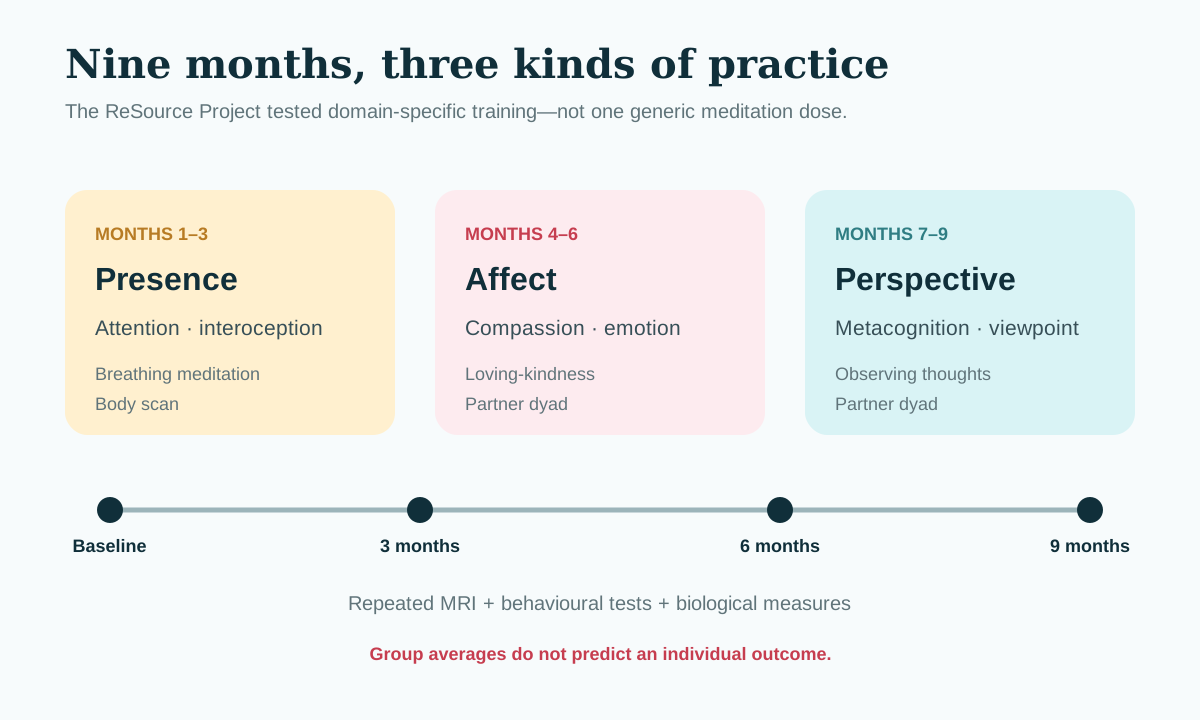
The ReSource Project instead recruited hundreds of healthy adults, used training and retest-control cohorts, and measured participants repeatedly. The programme combined daily exercises, weekly instruction and introductory retreats. This makes the evidence stronger than a one-time expert comparison, although it remains an intensive research programme rather than a typical meditation app.
What the three modules trained
Presence used breathing meditation and body scan to cultivate present-moment attention and interoception. Affect combined loving-kindness practice with structured partner exercises intended to train compassion, gratitude and dealing with difficult emotion. Perspective used observing-thought practice and partner exercises to train metacognition and perspective-taking.
That distinction is central. “Meditation” was not treated as a single mental state. Each module rehearsed particular skills, and the researchers asked whether its effects aligned with brain systems and behaviours relevant to those skills.
What the MRI analysis found
The structural MRI paper reported spatially different cortical-thickness changes after the modules. Presence training was associated mainly with change in prefrontal regions; Affect with frontoinsular regions; and Perspective with inferior frontal and lateral temporal areas. Changes within the same individuals correlated with improvements in domain-relevant measures of attention, compassion or cognitive perspective-taking.
This pattern is more informative than a claim that the whole brain “grew.” MRI-derived cortical thickness is a model-based anatomical measure. A small regional change is not a direct count of new neurons, and greater thickness is not automatically equivalent to better health. Hydration, scanner and analysis choices, normal variation and multiple comparisons all matter when reading structural findings.
Stress results added another layer
In a related experiment with 313 participants, all three practice types reduced self-reported stress during a standard laboratory challenge. Cortisol reactivity fell after the two socially oriented modules, Affect and Perspective, but not after attention-focused Presence. Other autonomic and immune markers did not change. The mismatch is useful: feeling less stressed and showing a smaller hormone response are related questions, not interchangeable proof.
A later analysis reported cumulative increases in serum BDNF across training and associations with lower cortisol and dentate-gyrus volume change. However, after nine months the training cohorts’ BDNF was not higher than the control cohort because the controls showed unexplained variability. The authors explicitly cautioned that single serum BDNF measurements are unreliable for preventive-health conclusions.
What the study cannot tell you
| Supported interpretation | Overreach |
|---|---|
| Targeted practice can be associated with domain-specific change | Any meditation produces the same brain effect |
| Group averages changed over repeated assessments | Every individual will show a visible MRI change |
| Some structural changes tracked task improvements | Brain thickness proves enlightenment or superior wellbeing |
| Healthy adults completed an intensive programme | The programme is a proven treatment for a disorder |
The practical takeaway
Choose a practice by the skill you want to rehearse. Attention practice, compassion practice and perspective-taking ask different things of the mind. Judge usefulness through tolerability and daily functioning, not a promise to reshape one brain region. People with trauma, panic, psychosis risk or destabilising experiences may need shorter externally anchored practice or professional guidance.
Sources and further reading
- Valk et al. (2017): Structural plasticity after targeted mental training
- Engert et al. (2017): Stress reactivity after three training types
- Kok and Singer (2017): Differential effects of four meditation practices
- Puhlmann et al. (2025): BDNF, cortisol and dentate-gyrus findings after contemplative training