Brainwave Frequencies and Meditation: What EEG Can Show
EEG can reveal patterns associated with meditation, but it cannot measure enlightenment or identify one ideal brainwave state. A guide to gamma findings, artefacts and the difference between state and trait.
 Maya ChenMind & Brain editor5 September 2026
Mind & Brain · Study digest
EEG can detect patterns associated with meditation, but it does not reveal a single “meditative brain state.” The meaning of any frequency change depends on the practice, the comparison condition and the way the signal was recorded.

In short
- EEG records tiny voltage differences at the scalp, offering excellent timing but limited information about exactly where a signal began.
- Meditation studies report changes across several frequency bands; no band is an agreed measure of depth, skill or wellbeing.
- Gamma findings are scientifically interesting and technically fragile because facial and neck muscles also generate high-frequency activity.
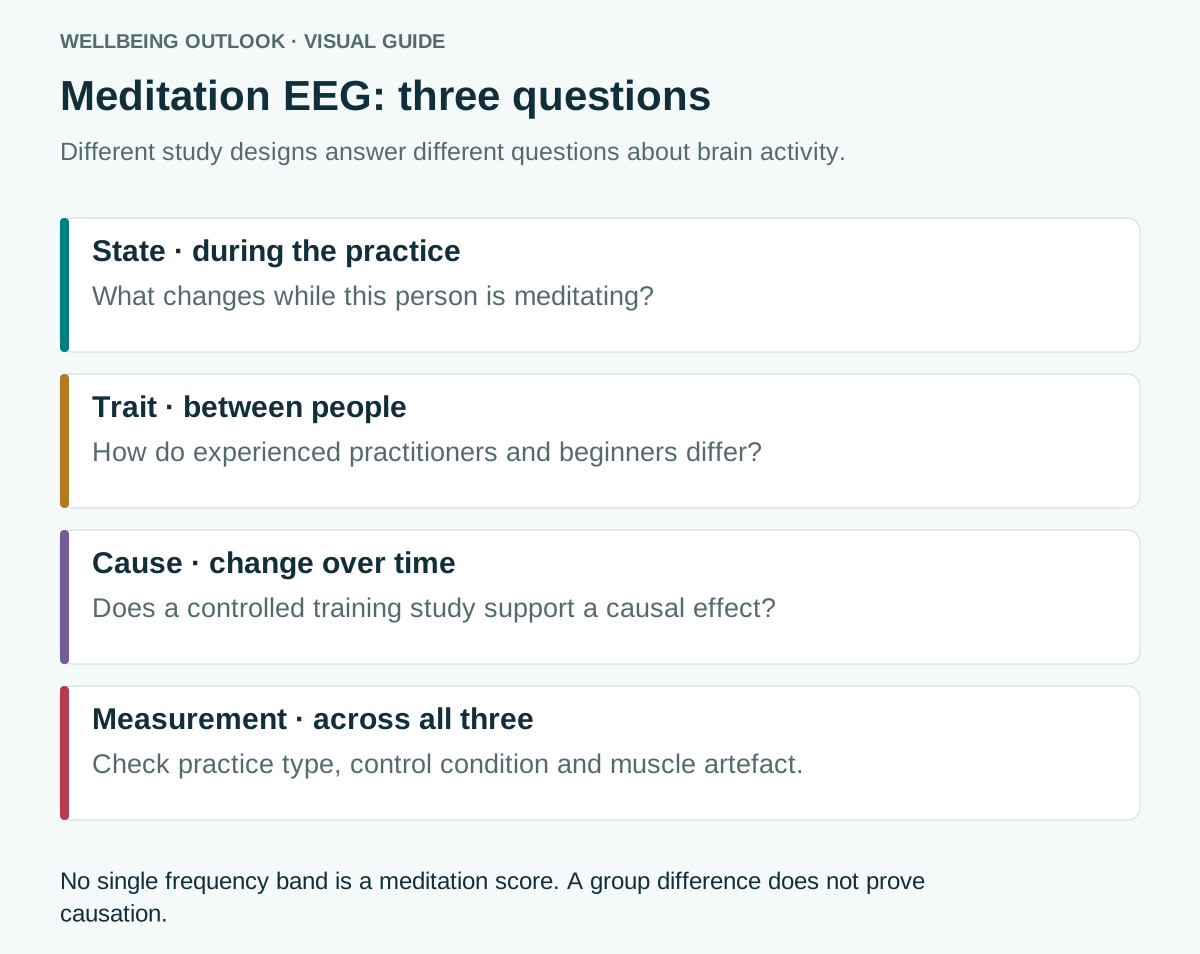
- Differences during a session are state effects; differences found at rest in experienced practitioners may be trait effects, but they do not by themselves prove that meditation caused them.
What EEG actually measures
Electroencephalography, or EEG, uses electrodes on the scalp to record electrical potential differences produced mainly by the coordinated activity of large populations of cortical neurons. It can follow changes over milliseconds, which makes it useful for studying attention and transitions between mental states. The scalp, skull and surrounding tissues blur the signal, however, so EEG is less precise about location than its colourful maps may suggest.
Researchers often summarise activity by frequency: how many times a pattern oscillates per second. Labels such as alpha or gamma are convenient ranges, not separate switches inside the brain. The ranges can overlap between laboratories, and the same frequency may participate in different processes depending on where, when and under what task conditions it appears.
“Meditation” is not one experimental condition
Focused-attention practice repeatedly returns attention to an object such as the breath. Open-monitoring practice observes experience without selecting one object. Compassion practices deliberately cultivate a social and emotional orientation. Mantra, movement and non-dual practices add still more variation. Combining them under one label can conceal meaningful differences.
The comparison matters too. Sitting with eyes closed naturally changes alpha activity. Relaxing, becoming drowsy, regulating breathing or expecting a benefit can each alter an EEG without being unique to meditation. A strong study therefore defines the practice, monitors wakefulness, specifies the reference condition and reports how artefacts were removed.
A practical map of the frequency bands
| Band | What meditation studies may report | Why interpretation stays cautious |
|---|---|---|
| Delta | Slow activity, sometimes during very deep relaxation | Delta is prominent in deep sleep; movement and eye artefacts can also appear slow |
| Theta | Changes linked with internal attention or reduced external engagement | Drowsiness is a major alternative explanation, and pooled findings are inconsistent |
| Alpha | Often increased during quiet, eyes-closed or internally directed conditions | Alpha is not specific to meditation and depends strongly on the control condition |
| Beta | Changes during active attention, monitoring or cognitive control | Muscle tension can contaminate higher beta frequencies |
| Gamma | Local power or synchrony changes during some intensive practices | Small muscle contractions overlap the same frequency range |
This table is not a ladder from “low” to “high consciousness.” Brain rhythms coexist, and a useful interpretation normally considers their timing, location, phase relationships and behavioural context rather than rewarding the largest number.
Why the 2004 gamma study became famous
A widely cited study led by Antoine Lutz compared a small group of long-term Buddhist practitioners with meditation-naive controls. During a compassion-oriented practice, the researchers reported unusually high-amplitude gamma-band activity and long-distance phase synchrony in the practitioners. The ratio of gamma activity to slower activity also differed between groups at baseline and was associated with lifetime practice hours.
The study was important because it showed that a deliberately cultivated mental practice could be examined with rigorous temporal measures. It did not establish a universal meditation signature, identify the world’s “happiest brain” or prove enlightenment. The groups were small and not randomly assigned to years of training, so lifestyle, selection and other pre-existing differences could contribute to the result.
What the wider evidence now suggests
A 2026 systematic review and meta-analysis pooled EEG findings from adult meditation studies. It found positive pooled effects for alpha, beta and gamma activity, while the pooled theta effect was not statistically significant. The authors also reported substantial heterogeneity and predominantly cross-sectional evidence. In plain language, there may be recurring patterns, but the studies vary too much to support one simple frequency recipe.
An earlier critical review reached a similar methodological conclusion: inconsistent meditation definitions, small samples, variable signal processing and incomplete reporting limit comparison and generalisation. A result can be real within one experiment without becoming a diagnostic marker or a target that everybody should try to reproduce.
Gamma is especially easy to overread
Gamma generally refers to relatively fast oscillatory activity, although laboratories use different cut-offs. It is studied in relation to sensory binding, attention, working memory and other processes—not only meditation. At the scalp, it also occupies frequencies heavily affected by electrical activity from the forehead, jaw, eyes and neck.
In one experimental demonstration, paralysis of scalp muscles sharply reduced much of the apparent high-frequency EEG signal. This does not mean that all scalp gamma is artefact. It means that convincing gamma research needs careful electrode placement, concurrent muscle monitoring or robust artefact procedures, and interpretations that match the limits of the measurement.
State, trait and cause are different questions
A state effect appears while someone is practising compared with an appropriate control period. A trait difference appears outside the practice, for example during resting EEG in experienced practitioners. A training trial that measures people before and after assignment can test causation more directly than a one-time comparison between experts and beginners.
These questions should not be collapsed. Years of practice may change attention-related networks, but people who sustain years of meditation may also differ in sleep, education, community, health behaviour or motivation. Dose-response associations with lifetime hours are useful clues, not automatic proof of cause.
What consumer headbands can—and cannot—tell you
A small wearable may help structure a practice or give repeatable feedback about stillness under consistent conditions. With few dry electrodes and proprietary algorithms, it cannot provide the same signal quality or transparency as a research system. A label such as “calm,” “focused” or “deep” is an algorithmic estimate, not a clinical finding.
Do not chase a frequency by tightening the jaw, forcing the breath or judging every session against a score. The most useful outcomes of meditation are usually behavioural and experiential: whether practice is tolerable, whether attention returns more readily and whether it supports daily functioning. For some people—particularly those with trauma, panic, psychosis risk or destabilising experiences—unguided intensive meditation may be uncomfortable and professional guidance can be appropriate.
How to read the next meditation-EEG headline
- Identify the practice. “Meditation” alone is not enough.
- Check the comparison. Eyes open, eyes closed, relaxation and an active task answer different questions.
- Look at the design. A cross-sectional expert comparison is not the same as a randomised training study.
- Ask about artefacts. This is essential for beta and gamma claims.
- Prefer converging outcomes. EEG is more informative when paired with behaviour, experience and replication.
Sources and further reading
- Lutz et al. (2004): Long-term meditators self-induce high-amplitude gamma synchrony
- Systematic review and meta-analysis of EEG activity in meditation (2026)
- Deolindo et al. (2020): Critical analysis of electrophysiological meditation research
- Muthukumaraswamy (2013): High-frequency MEG/EEG activity and muscle artefacts