Seven Ways Music Can Influence Mood and Attention
Music can shape reward, arousal, memory and attention, but the effect depends on the listener, track, task and setting. Seven evidence-aware routes—and a way to test your own.
 Jonas ReedCalm Signal editor5 September 2026
Calm Signal · Science guide
Music can change pleasure, arousal, memory and the direction of attention. Its effects are real but conditional: the listener, the task, the track and the setting matter more than a universal “focus frequency.”

In short
- Enjoyed music can recruit reward networks and influence mood and motivation.
- Background music may improve task focus for some listeners while worsening accuracy or language processing for others.
- Preference, familiarity, lyrics, volume, tempo and task difficulty all modify the result.
- Music therapy is a structured clinical practice; it is not interchangeable with playing a generic wellness playlist.
There is no single “effect of music”
A lullaby, a dance track, an unfamiliar symphony and a favourite song associated with grief are all music, but they differ acoustically and personally. Listening while resting is also different from listening while reading, exercising or receiving care. Studies that average across these conditions can answer broad questions while missing the reason one listener responds differently from another.
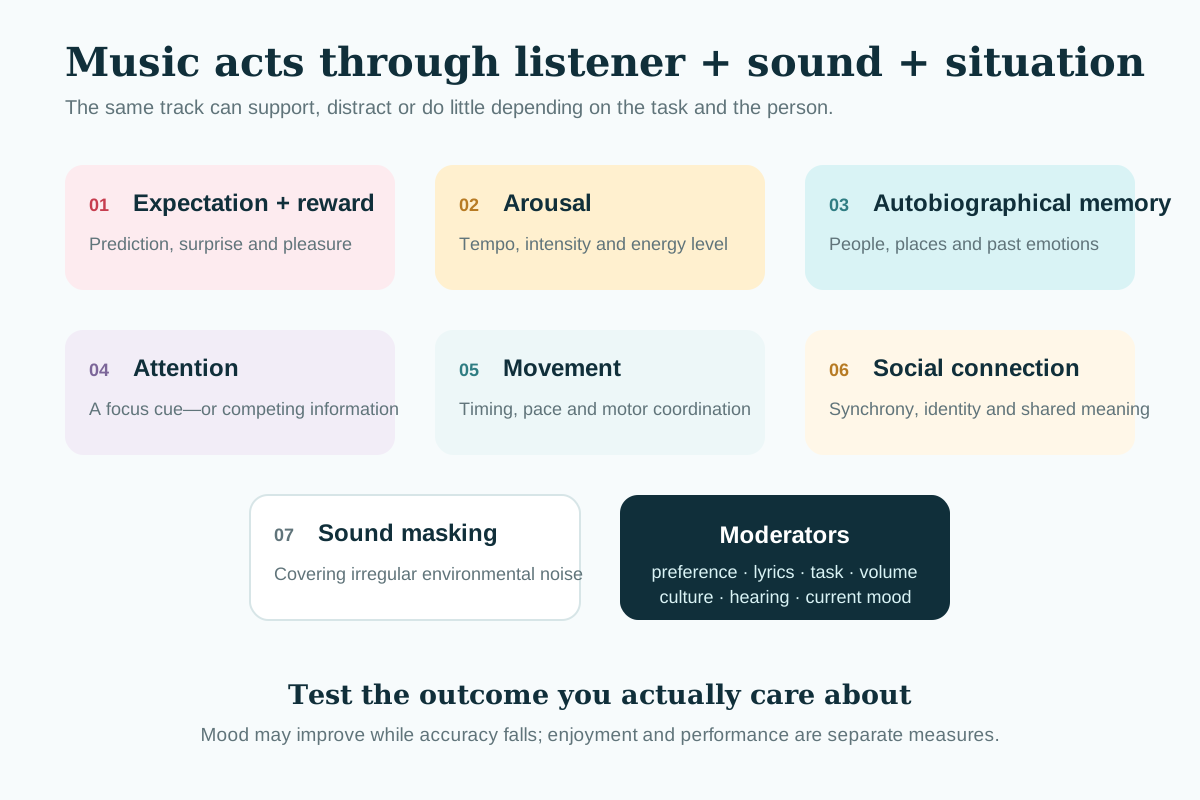
A useful model has three parts: the properties of the sound, the listener’s history and current state, and the demands of the situation. Change any one and the outcome may change.
1. Expectation and reward
Music creates patterns and then fulfils, delays or violates them. In a small double-blind pharmacological study, increasing or blocking dopamine availability produced opposite changes in musical pleasure and motivation, supporting a causal role for dopamine in reward from music. The finding does not mean every enjoyable track creates the same chemical response or that “dopamine music” is a clinical category.
2. Arousal can move up or down
Tempo, intensity, rhythm and familiarity can influence felt energy. A lively track may support movement or counter low alertness; a predictable quiet piece may help some people settle. A 2024 systematic review found mixed or insufficient evidence linking autonomic measures, auditory stimulation and cognitive performance. Feeling more energised and performing better are related hypotheses, not the same outcome.
3. Music can cue autobiographical memory
A song becomes linked with places, people and life periods. Hearing it can retrieve emotion and detail that are not properties of the recording itself. This makes personal choice important in reminiscence and care, and also means a supposedly calming track can be upsetting. Ask what the music means to the listener rather than relying only on genre.
4. Attention may be supported—or divided
Music can provide stimulation, mask irregular noise and reduce mind-wandering for some people. In two online experiments among people who habitually use background music, preferred music increased task focus and sped responses during a vigilance task, while also increasing some external distraction. Results from one task and self-selected listeners do not generalise to complex reading or safety-critical work.
Lyrics are especially likely to compete with language-based tasks. Novel, loud or highly engaging music can also capture attention. For editing, calculation or learning unfamiliar material, silence or predictable instrumental music may be the better comparison.
5. Rhythm can organise movement
A clear beat supports timing and can influence pace, coordination and perceived effort. Clinical rhythmic auditory stimulation uses this property in structured rehabilitation. Everyday listeners may find that music makes walking or exercise more enjoyable, but volume, traffic awareness and safe technique still matter.
6. Shared music can create social connection
Singing, dancing and attending performances coordinate attention and action. Music also communicates group identity and emotion without requiring identical interpretation. The benefit is not only acoustic: belonging, participation and shared memory may be central.
7. Music can mask another sound
Continuous music may cover unpredictable office or household noise, making the environment feel more controllable. Masking does not remove hazardous noise, and turning headphones up to compete with a loud setting increases hearing risk. Reduce the environmental sound or use isolation before increasing volume.
A simple personal listening experiment
| Question | Compare | Measure |
|---|---|---|
| Does music help this task? | Chosen music versus quiet on similar days | Accuracy, completion and mind-wandering |
| Do lyrics compete? | Familiar instrumental versus lyrical tracks | Reading recall or writing errors |
| Does it support mood? | A chosen track versus usual routine | Mood before and ten minutes after |
| Is the volume safe? | Current level versus better isolation | Whether speech can still be heard and ears feel normal |
Change one variable at a time and test the outcome you care about. A playlist that improves mood may still slow proofreading; that is not a contradiction.
Music listening and music therapy are different
Listening for enjoyment or self-regulation can be valuable. Music therapy involves an appropriately trained professional, defined goals and an individualised therapeutic relationship. Evidence from clinical programmes cannot automatically be transferred to a streaming playlist labelled with the same outcome.
Persistent low mood, anxiety, cognitive change or functional impairment deserves appropriate care. Music may be a support, not a substitute.
Sources and further reading
- Chee et al. (2024): Music, auditory stimulation, arousal and cognition—systematic review
- Ferreri et al. (2019): Dopamine modulates music-evoked reward
- Kiss and Linnell (2024): Background music, mood and sustained attention
- Systematic review: Can music counteract mental fatigue?
- Liu (2026): Music listening, emotional wellbeing and cognition—systematic review