Neuroplasticity Without the Buzzwords
Neuroplasticity makes learning and recovery possible, but change is task-specific, constrained and not proven by a colourful scan or marketing promise.
 Maya ChenMind & Brain editor5 September 2026
Mind & Brain · Explainer
Neuroplasticity is the nervous system’s capacity to change with development, experience, learning, injury and disease. It makes adaptation possible; it does not mean the brain is infinitely rewritable.
In short
- Plasticity includes changes in synaptic strength, networks, structure and function across different timescales.
- Learning is often specific: getting better at one task does not guarantee broad cognitive transfer.
- Repetition matters, but so do timing, challenge, salience, feedback and recovery.
- Plastic change can be helpful, neutral or maladaptive; “more plasticity” is not always better.
A capacity, not a product
The brain changes continuously as it learns and adapts. Connections can strengthen or weaken, networks can reorganise and structural measures can shift with experience. Developmental plasticity is especially powerful, but adult brains retain meaningful capacity for learning and recovery.
“Neuroplastic” has become a marketing adjective for apps, supplements, music and coaching. The word alone says nothing about whether an intervention works. Every claim still needs a defined outcome: what ability changed, by how much, for how long and compared with what?
Performance change is not the same as a scan change
Researchers can measure behaviour, electrical activity, blood flow and aspects of tissue structure. Each method is indirect and operates at a different scale. A colourful difference on functional MRI is not proof that a person became healthier, smarter or permanently transformed.
Practice effects, motivation and familiarity can improve test performance without broad transfer. Conversely, meaningful functional recovery may occur through strategies and compensation even when a chosen imaging measure changes little. Clinical importance belongs to what the person can do and values, not to how dramatic a visual looks.
Principles that help learning
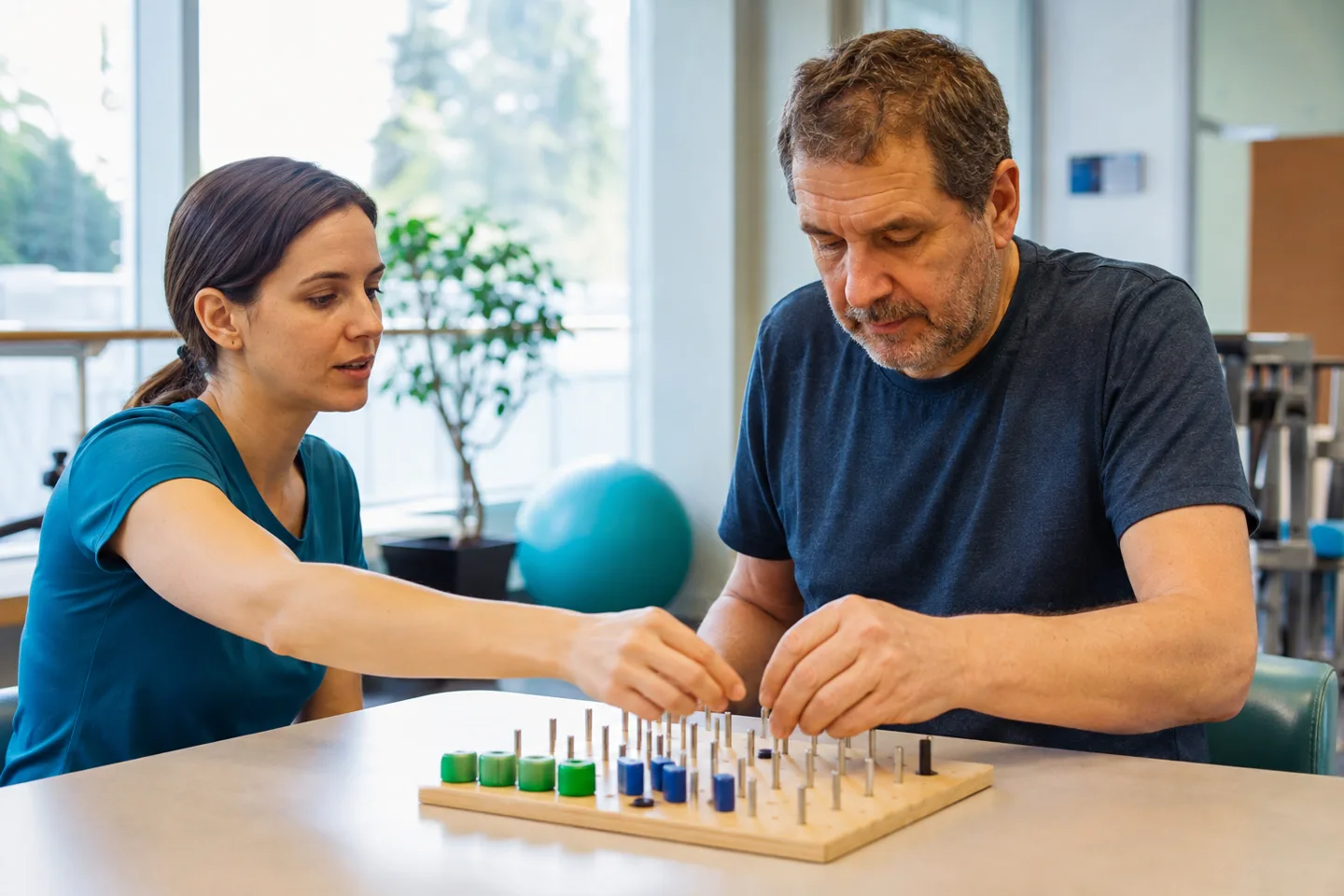
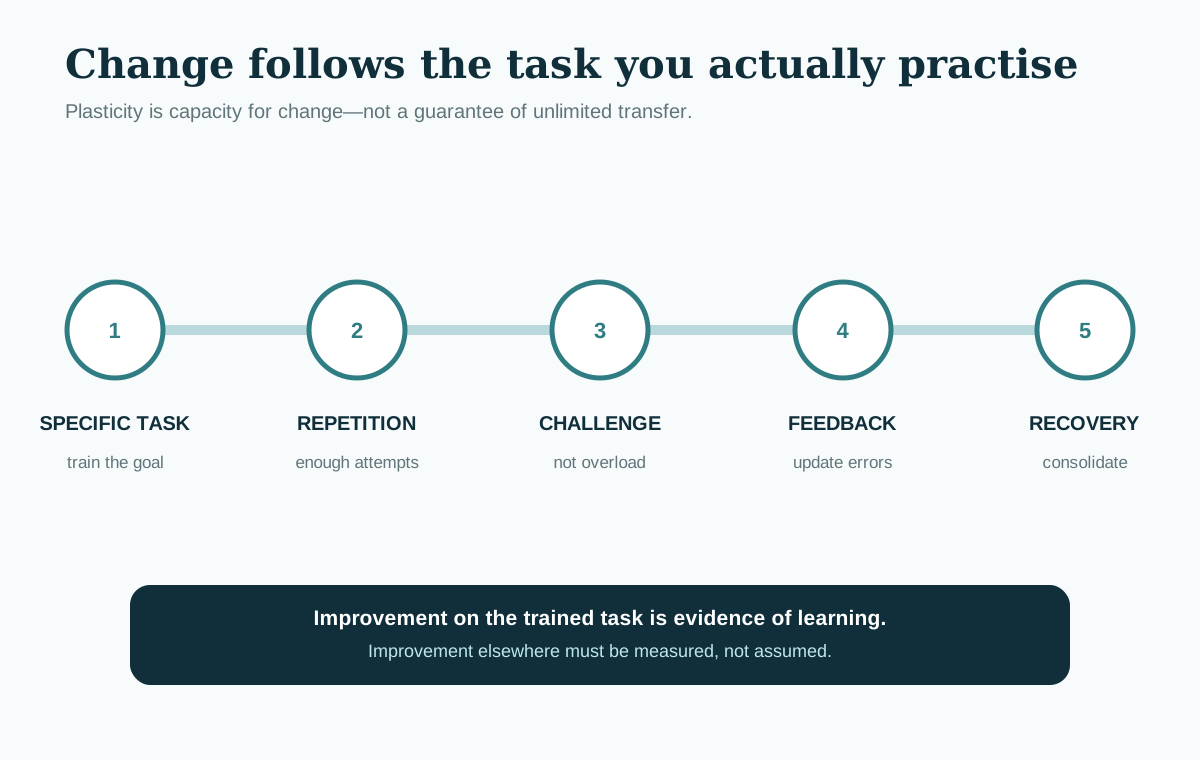
Rehabilitation science often highlights specificity, repetition, intensity, timing and salience. Practice should resemble the target function; there must be enough appropriate attempts; challenge should be sufficient but tolerable; timing after injury and within sessions matters; and personally meaningful tasks may support engagement.
Feedback helps update errors, while spacing and sleep can support consolidation. More repetitions are not automatically better if technique deteriorates, pain escalates or fatigue prevents useful learning. The effective dose depends on condition, goal and person.
Transfer is the hard part
| Training result | Interpretation |
|---|---|
| Faster on the practised puzzle | Evidence of task learning. |
| Better on a similar untrained puzzle | Near transfer, which should be measured. |
| Better everyday memory or work performance | Far transfer; a stronger and less common claim. |
| Different activation on a scan | Neural correlate requiring behavioural and clinical interpretation. |
| Testimonials of feeling sharper | Useful experience, but not controlled evidence of cognitive change. |
Plasticity after injury
After stroke or brain injury, recovery can involve restoration, compensation and learning new strategies. Task-specific therapy can drive useful change, but biological damage, timing, fatigue, mood and access to rehabilitation constrain outcomes. Plasticity is a reason for structured hope, not a promise of complete recovery.
Claims that a passive audio track, light pattern or supplement “activates neuroplasticity” skip the important questions. Even if a neural measure changes, the intervention must improve a meaningful function safely and reproducibly.
Plasticity can also maintain problems
Persistent pain, addiction, anxiety and tinnitus can involve learned predictions and network changes. Calling these conditions “just rewiring” is reductive and can blame the person. Adaptation occurs within biology, environment and history; changing it may require medical, psychological, social and behavioural support.
Habits are not literally fixed pathways that disappear after a magic number of days. New responses become more available through repeated context-specific practice while old responses may remain possible.
A practical way to use the concept
- Name the behaviour or function you want to change.
- Choose a safe task that rehearses it directly.
- Make the challenge adjustable and repeatable.
- Use feedback that supports correction rather than shame.
- Measure real-world function and retention, not only session performance.
- Change the plan if gains do not transfer.
For neurological symptoms or rehabilitation after injury, work with qualified clinicians. Sudden weakness, speech difficulty, facial droop, severe new headache or loss of coordination requires emergency assessment.