Can Rhythmic Audio Help You Shift Mental State?
Rhythmic audio cannot control the brain on command, but it may support transitions in attention and arousal. A practical guide to choosing and testing a session without frequency hype.
 Jonas ReedCalm Signal editor5 September 2026
Calm Signal · Practical guide
A track cannot force the mind into a selected state. But rhythm, repetition, music and a protected listening window can change the conditions in which attention and arousal operate. The useful question is not “Which frequency controls my brain?” It is “Which session helps me make the transition I need?”
In short
- Rhythmic audio can evoke time-locked neural responses and may influence subjective state.
- Music, expectation, breathing, context and taking a pause may contribute alongside the beat itself.
- Different techniques—binaural, monaural and isochronic—deliver rhythm differently.
- Choose by goal and tolerability, then evaluate the response over several sessions.
What “shifting state” should mean
State change does not need to mean an altered state of consciousness. In ordinary life it may be the movement from mental overdrive to a quieter evening, from scattered attention to a defined task, or from wakeful rumination toward sleepiness.
Those transitions involve more than EEG frequency. They include muscle tension, breathing, expectations, sensory load and what the person is about to do. Audio can become a structured cue within that larger system.
Three ways rhythm can be delivered
- Binaural beats: a slightly different tone is sent to each ear, creating a perceived beat. Stereo headphones are required.
- Monaural beats: two tones are physically combined, producing an audible amplitude fluctuation that can be played through speakers.
- Isochronic tones: a sound pulses on and off at regular intervals, usually with a more obvious rhythmic edge.
The technique is only one part of the intervention. Carrier tones, music, loudness, session length and instruction can change the experience substantially.
Why the surrounding ritual matters
Starting a session also means sitting down, reducing incoming information and committing several minutes to one intention. Those ingredients can change subjective state even when the special acoustic component adds little. That is not a reason to dismiss the session. It is a reason to describe the mechanism honestly and design the whole experience well.
Expectation can influence self-reported calm, but “placebo” does not mean imaginary. Context and expectation are part of how people experience many interventions. The scientific question is whether a specific beat adds a reliable benefit beyond an equally credible comparison such as music, silence or guided relaxation.
What the evidence suggests
Controlled trials have reported reductions in situational anxiety in settings such as preparation for a medical procedure. A large 2025 experiment found that monaural beats embedded in music reduced self-reported anxiety, while beats alone did not show the same pattern. That result is a useful warning against attributing the whole effect to a nominal beat frequency.
Other trials and reviews report mixed findings across anxiety, cognition, physiology and sleep. In a 2025 preoperative study, both the binaural-beat group and a simple relaxation condition improved, while group differences in EEG alpha power were not found. The fairest conclusion is that auditory-beat sessions may help some listeners and contexts, but the specific mechanism and added value beyond music or quiet rest remain unsettled.
Match format to real-world use
| Need | Useful design features | Avoid |
|---|---|---|
| Evening transition | Gentle entrance, predictable arc, clear ending | Abrupt pulses or energising narration |
| Sleep preparation | Low volume, minimal variation, timer | All-night earbuds by default |
| Focused work | Low salience, stable texture, speaker option | Tracks that compete with language tasks |
| Acute tension | Short orientation, comfortable posture, easy exit | Promises that discomfort proves it is working |
Headphones are a delivery choice, not a potency score
Binaural protocols require separated left- and right-ear signals. Other rhythmic formats do not necessarily require headphones. If earbuds increase pressure, isolation or sensory discomfort, a speaker-compatible track may be the better intervention. The strongest subjective sensation is not automatically the most useful dose.
Choose a session by transition, not prestige
For mental overdrive
Choose a session with a gentle entrance and minimal narrative. The first goal is reducing the number of competing inputs. A dramatic or highly textured track can become another demand.
For accumulated physical tension
Pair the audio with a supported posture, slower exhalation and permission to move. If the jaw, shoulders or abdomen remain braced, a frequency label alone is unlikely to create comfort.
For the transition out of work
Use a consistent track only after capturing unfinished tasks. The audio then marks a credible boundary rather than trying to suppress reminders your brain still considers actionable.
For sleep preparation
Prefer predictable, low-volume sound without abrupt changes. Use a timer and reduce light. If a track makes you analyse whether it is “working,” it may be too cognitively engaging for bedtime.
For focused work
Test audio against silence or ordinary instrumental music. The best track is the one that supports the task without pulling attention toward itself. A “beta” label is not proof of better performance.
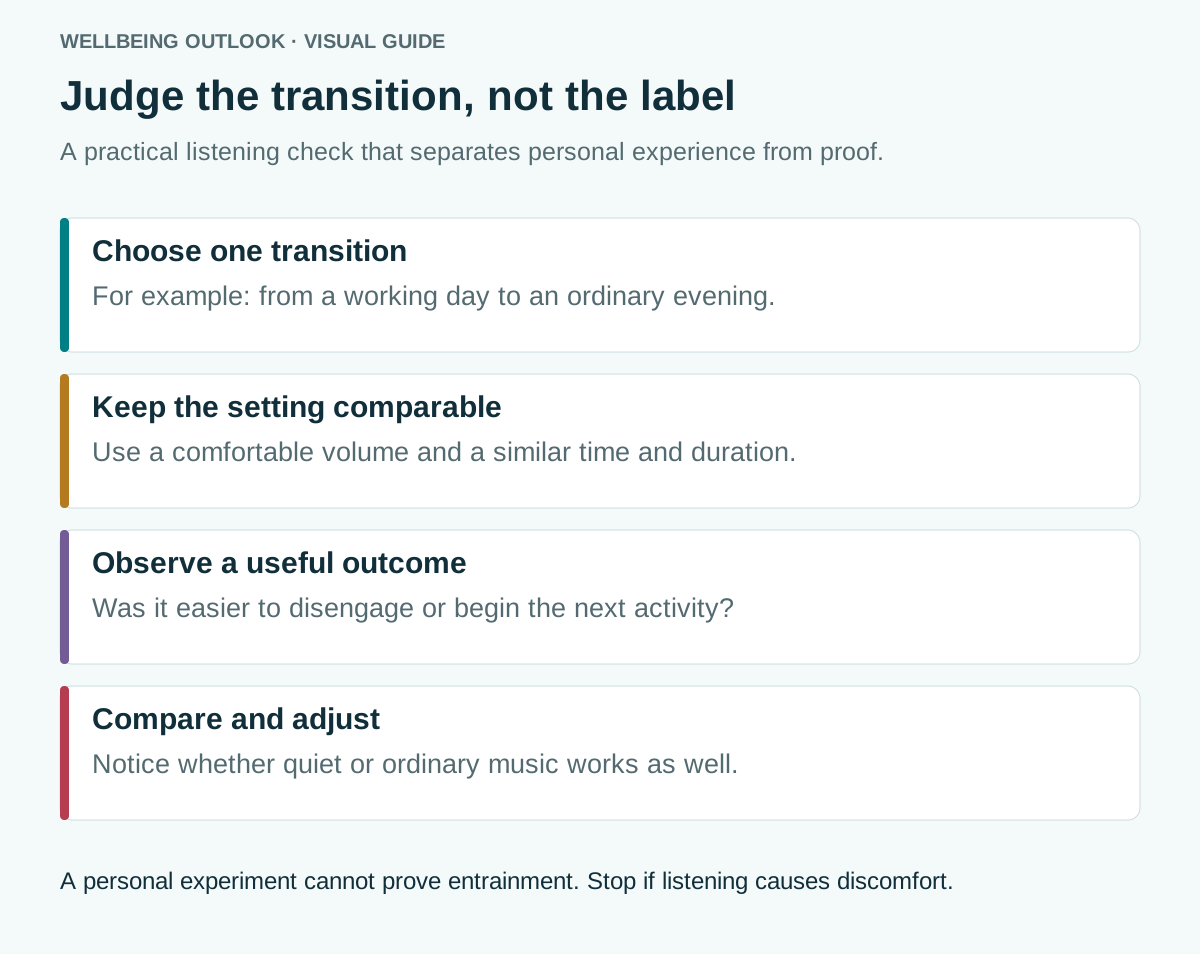
A five-session personal test
- Select one transition and one track.
- Use approximately the same time, place and comfortable volume.
- Before listening, rate the target state from 0 to 10.
- Listen for the stated duration without multitasking.
- Rate the same state immediately and ten minutes later.
- Repeat on five suitable days before deciding.
Also record unwanted effects. A track that produces a strong sensation but repeatedly leaves you irritable, dizzy or headachy is not a successful calming tool.
How programmes improve on random tracks
A guided programme can hold variables steady long enough to learn what helps. It can sequence shorter orientation sessions before longer immersive ones, explain the intention of each track, preserve a consistent safety protocol and ask the listener to notice the same outcome after each session.
That structure is more defensible than presenting a library of impressive frequency labels and asking the user to guess. The value lies in progression, context and adherence as much as in the audio file.
What not to infer
- A tingling sensation does not prove neural entrainment.
- Feeling calm does not prove that the whole brain entered one EEG band.
- A positive small trial does not establish treatment for a disorder.
- A poor response does not mean you failed to “receive” the frequency.
Safety boundary
Listen at a moderate volume in a secure setting. Never use relaxation or entrainment sessions while driving, cycling in traffic or operating machinery. Stop for ear pain, worsening tinnitus, marked dizziness, panic, disorientation or any concerning symptom. The World Health Organization recommends keeping personal-device volume below about 60% of maximum and monitoring cumulative exposure where possible.
Sources and further reading
- Venkatesan et al. (2025): Music with monaural beats, anxiety and mood
- Ostertag et al. (2025): binaural beats and preoperative anxiety
- Opartpunyasarn et al. (2022): Binaural beat audio during bronchoscopy—randomised trial
- Chee et al. (2024): auditory stimulation, autonomic arousal and cognition
- World Health Organization: safe listening