Sacred Frequencies: Cultural Meaning Versus Scientific Evidence
A frequency can hold cultural or personal meaning without a unique medical effect. How to respect experience while testing health claims by ordinary standards.
 Jonas ReedCalm Signal editor5 September 2026
Calm Signal · Evidence guide
A frequency can carry personal, spiritual or cultural meaning without having a unique medical effect. Respect the experience, name the history carefully and ask health claims to meet ordinary standards of evidence.
In short
- “Sacred frequency” is a modern cultural and marketing label, not a recognised medical category.
- Hertz measures cycles per second; it does not tell you volume, duration, timbre, context or health effect.
- Claims that 528 Hz repairs DNA or that other listed tones regenerate organs are not supported by robust clinical evidence.
- Music may still affect mood, attention, memory and connection through many features beyond one tuning number.
Begin with the experience, not the verdict
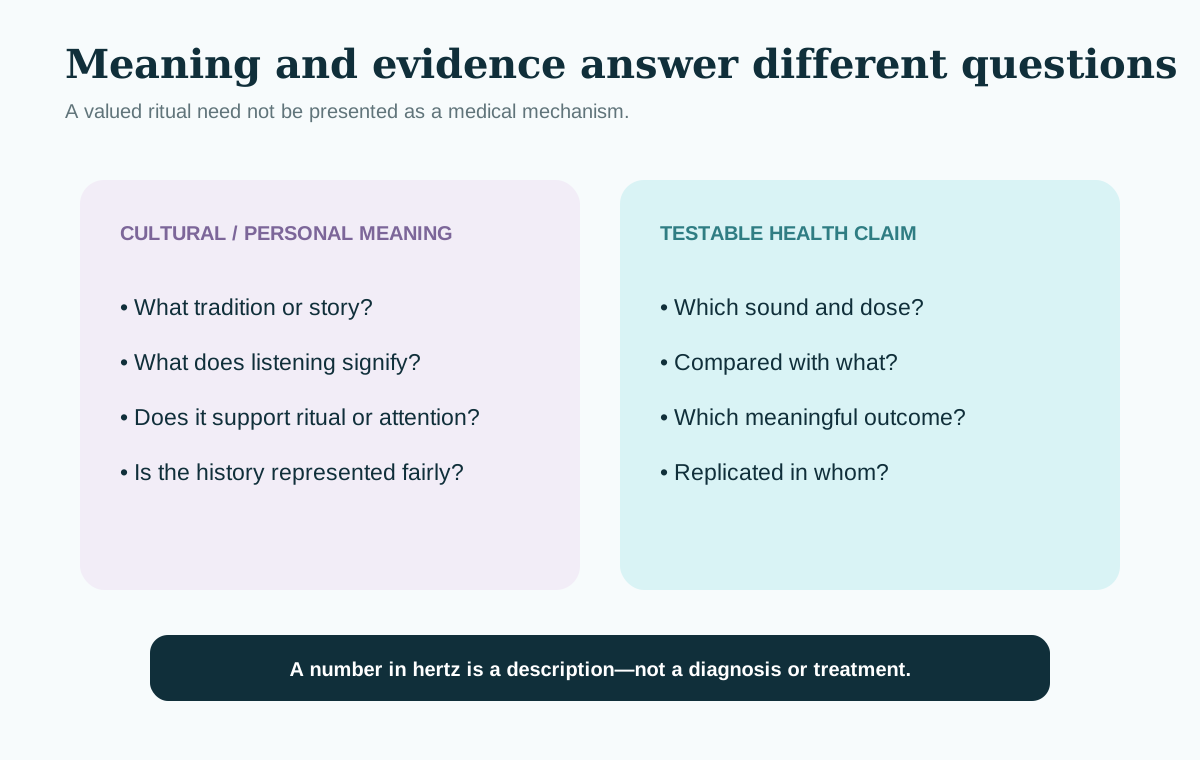
A listener may associate a tone with prayer, grief, safety, community or a meaningful routine. Those effects can be genuine as experiences. Expectation, memory, attention, repetition and setting shape what music does for a person. Calling that meaning “only placebo” misses its psychological and cultural reality.
A medical claim is different. “This track helps me settle” reports an experience. “This frequency repairs DNA, detoxifies cells or treats trauma” predicts a biological outcome. The second claim needs a defined exposure, comparison group, validated outcome, adequate sample, safety monitoring and independent replication.
What hertz does—and does not—describe
One hertz means one cycle per second. For an audible pure tone, frequency strongly contributes to perceived pitch. Music contains many simultaneous frequencies changing over time, plus rhythm, dynamics, timbre, spatial cues and silence. Two tracks labelled 528 Hz can be acoustically very different.
Sound-pressure level and duration help determine hearing risk. Delivery through speakers, headphones or a vibrating chair changes the exposure. A number in the title is therefore an incomplete dose and sometimes refers only to a tuning reference rather than a tone continuously present in the music.
Where the “Solfeggio” story comes apart
Guido of Arezzo’s medieval solmisation used the opening syllables of lines in the hymn Ut queant laxis—ut, re, mi, fa, sol and la—to teach relative pitch. Those syllables did not specify modern absolute frequencies such as 396 or 528 Hz. Historical pitch varied, and hertz as a unit came centuries later.
The now-popular sequence of six and later nine “Solfeggio frequencies” was promoted in the late twentieth century through numerological interpretation. That is a modern spiritual narrative, not a recovered medieval tuning standard. Cultural value does not require rewriting the chronology.
What research can legitimately test
Small studies have compared music tuned or centred differently and measured short-term anxiety, mood, heart-rate variability or other markers. Such experiments can generate hypotheses, but they often involve tiny samples, short exposures, incomplete blinding and many differences between audio tracks. A finding with one composition cannot isolate the labelled frequency unless every other relevant feature is controlled.
Broader research on music-based interventions has stronger evidence for some clinical and psychological outcomes, depending on population and programme. Those interventions may involve therapist relationship, preferred music, active participation, rhythm, expectation and repeated sessions. Their results do not validate a universal list of frequency-specific benefits.
A claim-checking table
| Claim | What evidence would be needed |
|---|---|
| “Repairs DNA” | A plausible exposure, validated molecular outcome, controls, human safety and independent replication. |
| “Releases fear” | A defined psychological measure and comparison with silence, other music and expectation controls. |
| “Detoxifies cells” | The toxin, biological pathway, dose and clinically meaningful removal must be specified. |
| “Balances relationships” | Relationship outcomes and mechanism, not a metaphor about neuronal or cellular harmony. |
How to listen without overclaiming
Choose the recording because you like its sound or meaning. Keep volume comfortable, particularly with headphones, and take breaks during long sessions. Treat relaxation as an outcome worth noticing without upgrading it to disease treatment.
Do not stop medication, delay diagnosis or spend unaffordable sums because a creator promises frequency-specific healing. Ask whether the exact track was tested, against what, in whom and for which outcome. Testimonials cannot reveal the effect of expectation, natural change or concurrent care.
Safety is about the real exposure
Hearing damage depends mainly on level and duration, not whether the frequency is called sacred. Low-frequency vibration delivered through furniture or devices is a different physical exposure and needs device-specific safety. People with sound sensitivity, tinnitus, migraine, trauma triggers or sensory processing differences may need shorter, quieter or optional listening.
Sudden hearing loss, severe vertigo, neurological symptoms or acute distress require appropriate assessment. A frequency label is not a diagnostic tool.