Safer Listening: Headphones Volume Driving and When to Stop
Use meditation audio, binaural beats and music without trading away hearing, balance or situational awareness. Practical rules for volume, duration, driving and warning signs.
 Jonas ReedCalm Signal editor5 September 2026
Calm Signal · Safety guide
A calming session should not ask you to trade away hearing, balance or situational awareness. These practical rules apply to meditation audio, binaural beats, sleep soundscapes and ordinary music.
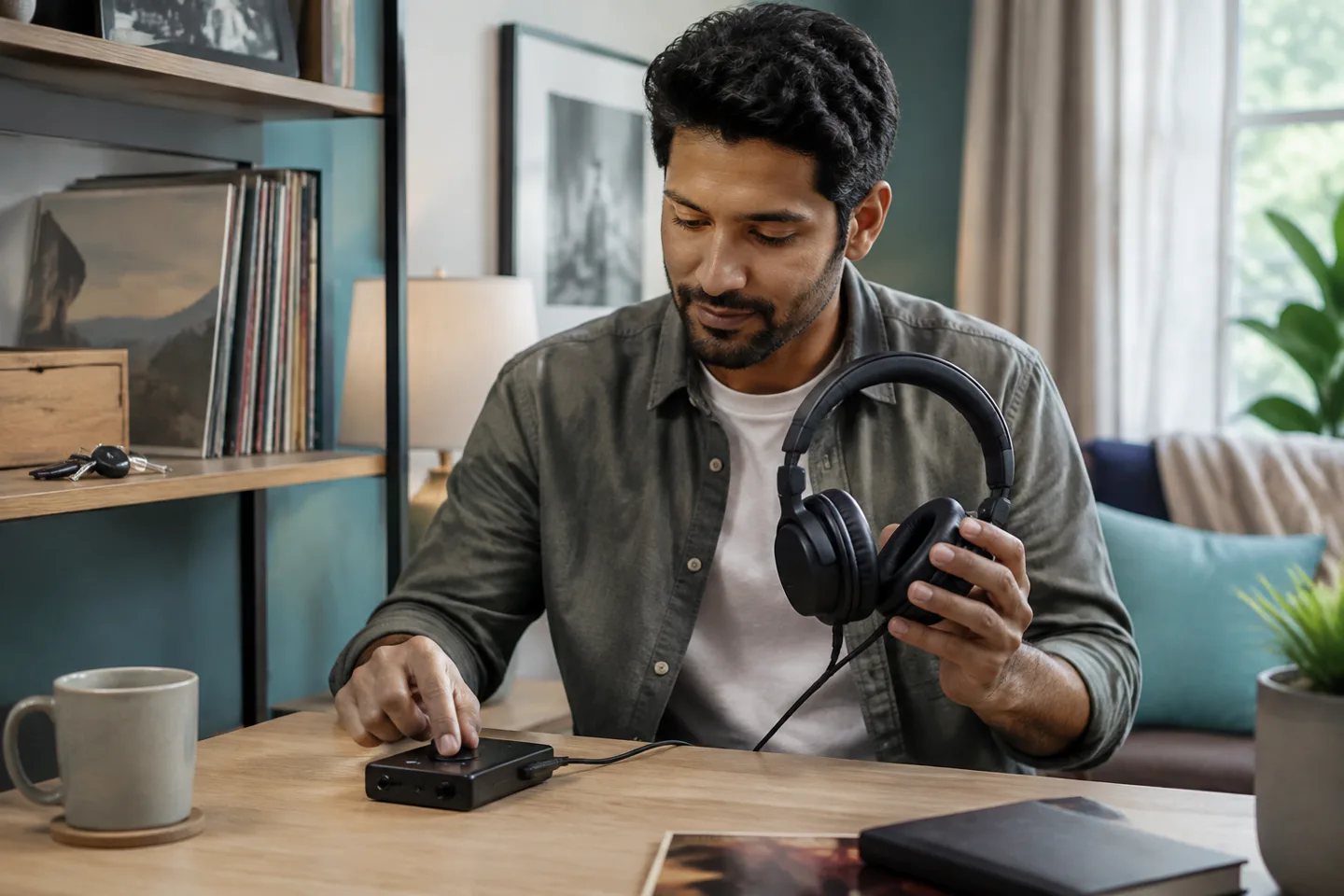
Before you press play
- Listen in a safe place where reduced attention will not put you or anyone else at risk.
- Start low. “Barely loud enough to hear comfortably” is usually a better starting point than immersive volume.
- Do not listen while driving, cycling in traffic, operating machinery or supervising a safety-critical situation.
- Stop for pain, sudden hearing change, strong dizziness, panic, disorientation or any symptom that concerns you.
Volume and time work together
Hearing risk is a dose: sound level multiplied by exposure time. A volume that is acceptable for a short period may become risky when repeated for hours. The decibel scale is logarithmic, so a small-looking increase represents a substantial increase in sound energy.
The World Health Organization uses 80 dB for up to 40 hours per week as an adult safe-listening reference. At 90 dB, its example allowance falls to about four hours per week. These are exposure benchmarks, not targets to reach. Quieter gives you more margin.
A phone’s percentage slider is not a calibrated decibel meter. The actual level depends on the device, headphones, recording and fit. WHO’s practical consumer rule—no more than about 60% of maximum—can be a useful ceiling, but many guided sessions will be comfortable well below it.
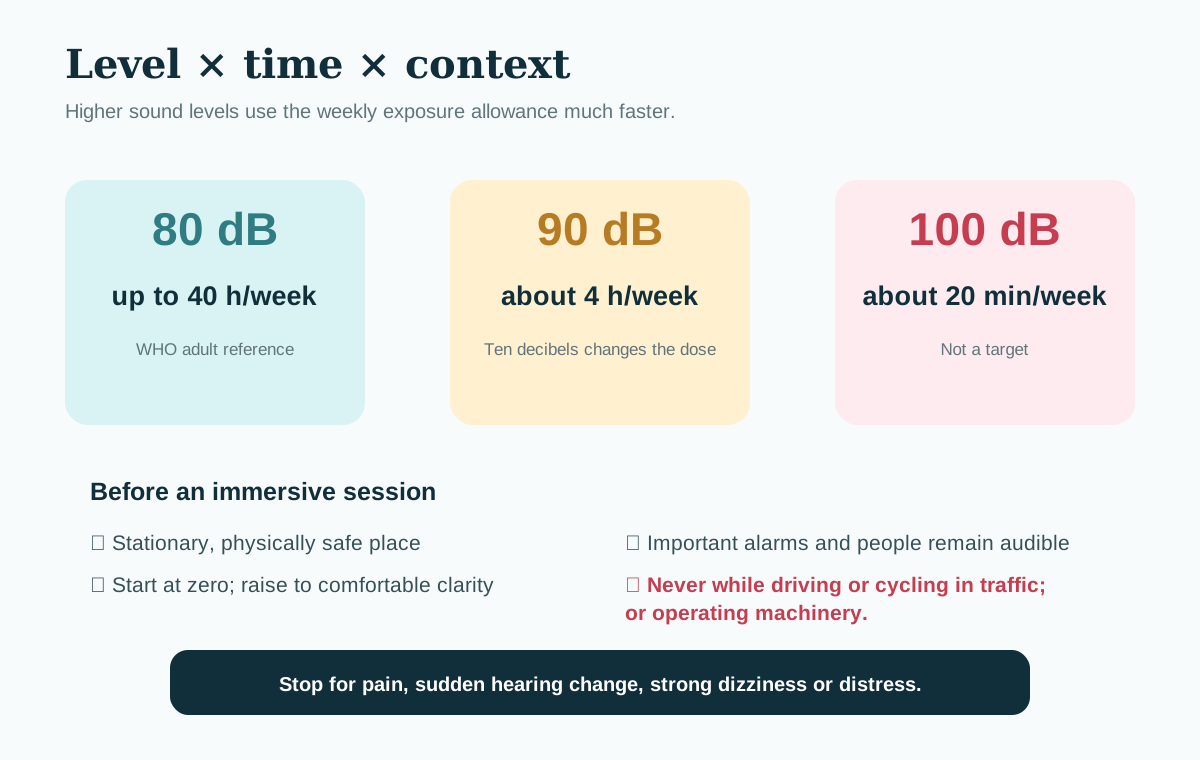
A simple volume check
- Set the volume to zero before putting on headphones.
- Raise it gradually until speech, tones or music are clear.
- Stop there; do not add volume merely to make the effect feel stronger.
- If your device provides headphone-level or weekly-exposure data, use it.
- Take listening breaks and reassess after changing tracks or devices.
Noise-cancelling or well-fitted headphones can help in loud environments because you do not need to overpower background noise. They do not make high playback levels harmless.
Headphones, speakers and sleep
Binaural beats require separate signals to each ear, so stereo headphones are normally part of the protocol. Isochronic tones, music and many guided sessions can work through speakers. If headphones feel uncomfortable, create pressure, worsen tinnitus or make you feel cut off from your surroundings, use a speaker-compatible session instead.
For sleep, consider a bedside or pillow speaker and a timer rather than sleeping all night in earbuds. The goal is to support a transition, not accumulate unnecessary exposure or create pressure in the ear canal. Keep alarms, children, smoke detectors and other important sounds audible.
Why driving is a hard no for immersive sessions
Guided relaxation deliberately redirects attention. Some sessions also encourage closed eyes, slow breathing, inward focus or drowsiness. Those effects are incompatible with driving, riding in traffic or operating machinery—even at a low volume.
Hands-free technology does not remove the duty to remain in full control. Laws differ by country, but the safety principle does not: if an audio is designed to narrow attention or change arousal, save it for a stationary, secure setting.
When to stop immediately
End the session and return to ordinary environmental sound if you experience:
- ear pain, pressure or a sudden change in hearing;
- ringing or buzzing that appears or clearly worsens;
- marked dizziness, spinning, loss of balance or nausea;
- panic, unusual agitation, disorientation or feeling detached in a distressing way;
- a headache or sensory discomfort that grows rather than settles;
- any aura or symptom that you recognise as preceding a seizure.
Do not push through because a track is labelled “healing” or because discomfort is described as a release. A wellness session does not need to feel intense to be useful.
When to seek professional advice
Arrange a medical or audiology assessment for persistent or recurring tinnitus, repeated dizziness, hearing difficulty, ear pain or symptoms that interfere with sleep and concentration. Seek urgent care for sudden hearing loss, tinnitus after a head injury, tinnitus with facial weakness or a severe spinning sensation, or other acute neurological symptoms.
If you have epilepsy, most audio is not automatically prohibited. Sound-triggered reflex seizures are rare. However, anyone with a known musicogenic or sound-sensitive pattern should follow their clinician’s advice and avoid personal triggers. If a session also includes flashing light, visual pulsing or a screen animation, treat that as a separate exposure and follow any photosensitivity guidance you have received.
Children, pregnancy and health conditions
Children have a lower WHO safe-listening reference than adults: 75 dB for 40 hours per week in the WHO–ITU device standard. A parent or guardian should control volume and duration and make sure the child can stop easily.
Pregnancy is not, by itself, a reason ordinary low-volume audio is unsafe. But “frequency” claims do not make a session a prenatal treatment. Anyone with a condition affected by dizziness, sensory stimulation, panic or drowsiness should choose a conservative setting and ask a clinician if unsure.
The Calm Signal listening protocol
- Place: seated or lying down somewhere physically safe.
- Purpose: choose one aim—settle, focus, transition or prepare for sleep.
- Level: begin at zero and raise only to comfortable clarity.
- Boundary: know the session length and use a timer if needed.
- Exit: when it ends, take a breath, open your eyes, orient to the room and stand slowly.
- Review: note how you feel now and ten minutes later. Stop using any session that repeatedly leaves you worse.