Solfeggio Frequencies: Nine Meanings and What We Actually Know
A reference to the nine modern Solfeggio numbers, their common cultural meanings and the evidence boundary around therapeutic claims.
 Jonas ReedCalm Signal editor5 September 2026
Calm Signal · Reference
Nine numbers circulate under the name “Solfeggio frequencies”. This guide records their common modern meanings without presenting those meanings as established biological effects.
In short
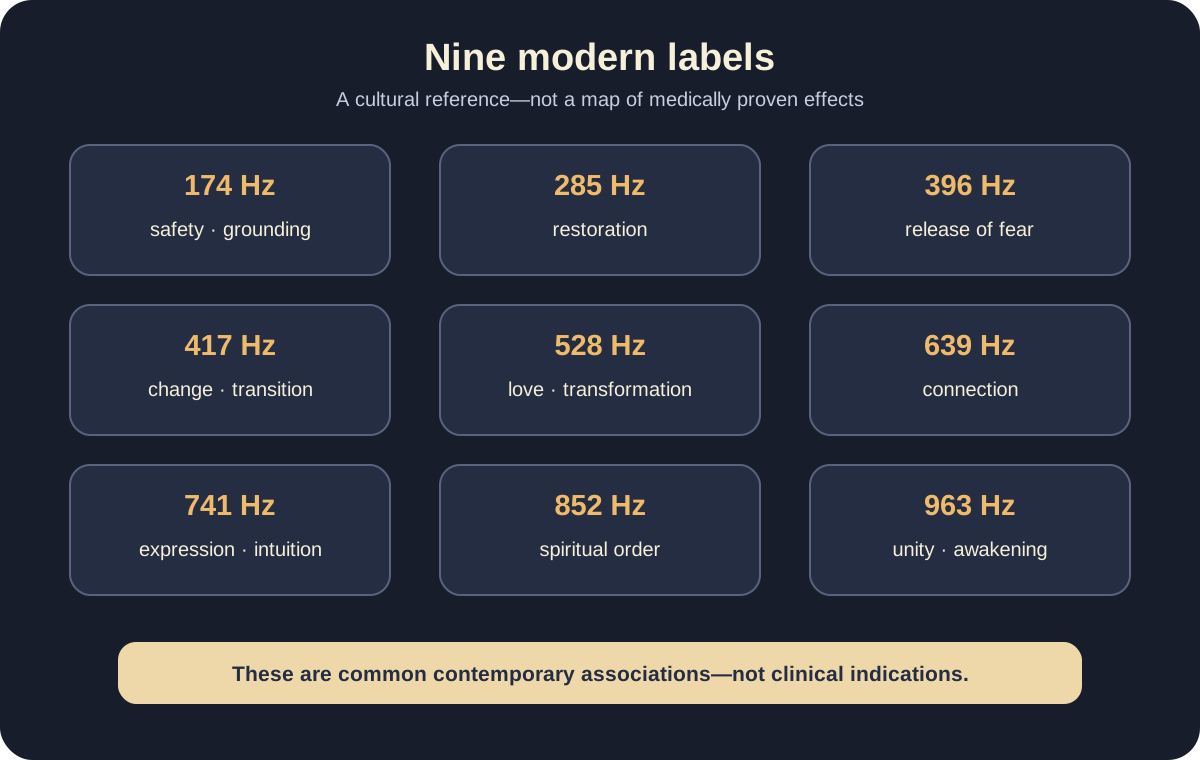
- The modern list is 174, 285, 396, 417, 528, 639, 741, 852 and 963 Hz.
- Its emotional and spiritual labels are contemporary associations, not clinically established functions.
- Guido of Arezzo’s medieval solmisation syllables described pitch relationships; they did not encode this set of absolute hertz values.
- You may use the tracks for listening, ritual or relaxation without treating them as a replacement for care.
The nine-number reference
| Frequency | Common modern label | Evidence boundary |
|---|---|---|
| 174 Hz | Safety, grounding or pain relief | No robust clinical evidence establishes a unique analgesic effect of 174 Hz. |
| 285 Hz | Restoration or tissue regeneration | The frequency has not been shown to regenerate human tissue. |
| 396 Hz | Release of fear or guilt | These are symbolic or experiential labels, not validated frequency-specific outcomes. |
| 417 Hz | Change, clearing the past | No frequency can be assumed to process trauma without an appropriate intervention and evidence. |
| 528 Hz | Transformation, love or “DNA repair” | Listening to 528 Hz has not been demonstrated to repair human DNA clinically. |
| 639 Hz | Connection or relationship harmony | Music may support shared experience, but one pitch does not repair relationships. |
| 741 Hz | Expression, intuition or “detoxification” | Detox claims need a named substance and measured biological pathway; the label supplies neither. |
| 852 Hz | Spiritual order or heightened intuition | This is a contemplative interpretation, not a medical or neurological diagnosis. |
| 963 Hz | Unity, awakening or higher consciousness | Spiritual language may be meaningful, but it is not a measurable universal treatment effect. |
What “Hz” actually tells you
Hertz means cycles per second. A pure tone at 528 Hz repeats 528 times each second and is perceived as a pitch. A musical recording is not one number: it contains a moving mixture of fundamentals, harmonics, rhythm, timbre, dynamics, spatial cues and silence. Two uploads with “528 Hz” in the title may therefore sound—and measure—very differently.
A label may mean that one tone is sustained, that a composition is tuned from a particular reference, or merely that the creator associates the track with the number. Without an acoustic analysis, the title does not specify the exposure.
The medieval name and the modern sequence
Guido of Arezzo is associated with medieval techniques that made singing easier to learn. The syllables ut, re, mi, fa, sol, la came from successive lines of the hymn Ut queant laxis and helped singers navigate relative intervals. This was a pedagogical system, not a nine-frequency wellness prescription.
Modern absolute frequency measurements, fixed reference pitches and electronic tone generation belong to much later history. The popular nine-number sequence was promoted through twentieth-century numerological and spiritual narratives. Calling it ancient Gregorian tuning collapses very different periods and technologies.
Why a track can still feel powerful
Music can shape arousal, attention, memory, expectation and social connection. Slow tempo, predictable phrasing, low volume, a comfortable timbre and a safe setting may help someone settle. Personal preference matters: a supposedly calming tone can feel irritating or threatening to another listener.
Ritual also changes attention. Repeating the same track before sleep may become a cue for winding down. A group practice may carry belonging. These routes are plausible without proposing that a chosen number opens chromosomes, purifies cells or transmits a universal energy.
What a frequency-specific study would need
To isolate 528 Hz, for example, researchers would need audio conditions matched for loudness, duration, tempo, timbre and expectation, differing only in the feature under test. Participants and assessors should be blinded where possible. Outcomes should be specified in advance, clinically meaningful and replicated independently.
A tiny before-and-after study, a change in one stress marker or a cell experiment cannot support claims of healing trauma, repairing DNA or treating disease. Broader music-therapy evidence also cannot be transferred automatically to one frequency because therapy may involve a trained practitioner, preference, active music-making and repeated sessions.
How to use the list responsibly
Choose a frequency as a theme, a ritual marker or a way to organise a playlist. Describe the result in first-person language: “I found this recording calming,” not “741 Hz detoxifies cells.” Keep the volume comfortable and the session optional. If a track worsens tinnitus, migraine, agitation or sensory distress, stop or change it.
For sleep, pain, trauma or anxiety, use the music as an adjunct if it helps—not as a substitute for assessment or evidence-based care. Do not discontinue medicine or postpone urgent evaluation because a recording is described as curative.
A quick credibility check
- Does the source distinguish personal meaning from a biological claim?
- Does it cite an identifiable study on the exact exposure and outcome?
- Were the comparison tracks matched, or could tempo, loudness and expectation explain the result?
- Is a laboratory observation being presented as a proven human treatment?
- Is the seller using certainty, conspiracy or urgency to sell access?
Specific numbers can create an impression of precision. Precision in a label is not the same as accuracy in a health claim.