Strength Training After Forty: A Sensible Starting Point
A two-day, full-body framework built around five movement families, moderate effort, gradual progression and safety signals—without heroic workouts.
 Priya ShahMovement & Mobility editor5 September 2026
Movement & Mobility · Practical guide
Forty is not a biological cliff. A small, progressive strength routine can support muscle, bone and everyday capacity—without chasing soreness, maximal lifts or a younger person’s programme.

In short
- Healthy adults benefit from strengthening major muscle groups on at least two days per week.
- Most sensible resistance programmes improve strength; consistency matters more than a theoretically perfect prescription.
- Begin with five movement families, moderate effort and room to recover.
- Sharp pain, neurological symptoms or unexplained chest symptoms are stop signals, not training challenges.
Why start now?
Muscle strength and power help with stairs, carrying, balance, work and recreation. Age-related changes happen gradually and differ widely between people; inactivity, illness, nutrition, sleep and training history all matter. Strength training is one of the most direct ways to give muscle and connective tissue a reason to adapt.
Research syntheses consistently find that resistance training improves strength and muscle size in healthy adults. The exact “best” combination of load, sets and frequency depends on the outcome and person, but many programmes work better than doing none. That is good news for beginners: the plan can fit your access, preferences and schedule.
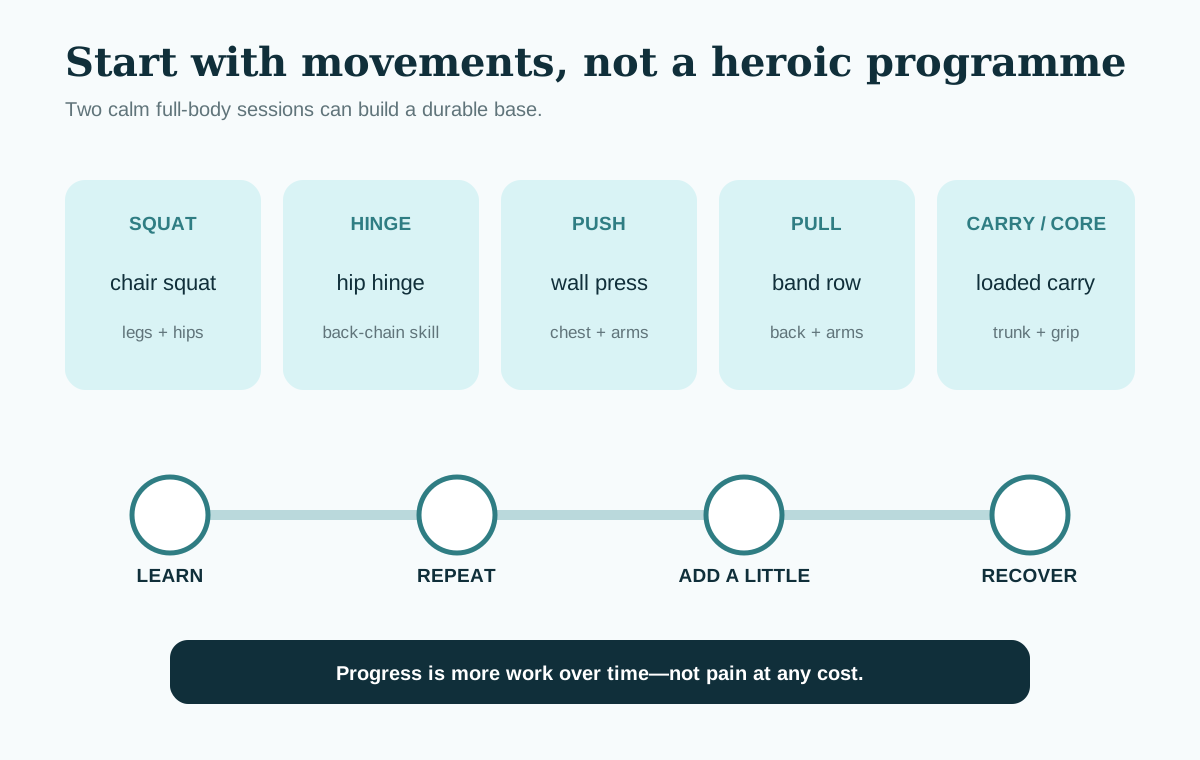
A two-day starting framework
On two non-consecutive days, choose one exercise from each family: squat, hinge, push, pull and carry or trunk stability. Examples include a chair squat, hip hinge with a light weight, wall or incline press-up, resistance-band row and a suitcase carry. Machines are also valid and can make loading simple.
After a brief warm-up, perform one or two sets of roughly 6–12 controlled repetitions per exercise. Finish each set while you could still complete about two or three technically sound repetitions. Rest long enough that breathing and control return. The numbers are a starting range, not a medical prescription.
How to choose the first load
The resistance should feel meaningful by the final repetitions but should not force breath-holding, jerking or loss of range. Body weight may be enough for one movement and too much for another. Lower loads can build muscle when sets are sufficiently challenging, while heavier loads tend to be more specific for maximal strength. Beginners do not need to train to failure.
Use a stable version to learn the pattern. Raising the height of a squat target, pressing against a wall or shortening a carry are legitimate adjustments. Adaptation comes from an appropriate challenge repeated over time, not from copying the most advanced variation.
Progress one variable at a time
| If this is true | Try this next |
|---|---|
| All repetitions are controlled with several left in reserve. | Add one or two repetitions within the planned range. |
| You reach the top of the range across sessions. | Add the smallest available amount of resistance. |
| Technique changes as fatigue rises. | End the set, reduce load or simplify the variation. |
| Soreness disrupts normal activity for days. | Reduce sets or effort and progress more slowly. |
| The session feels easy but time is limited. | Keep the five movements and add load before adding complexity. |
Recovery is part of the programme
Allow at least a day between early full-body sessions. Normal post-exercise soreness can appear later and usually eases over a few days, but soreness is not required for progress. Sleep, adequate food and protein distributed across meals support recovery; supplements are optional, not the foundation.
Track a few useful facts: exercise version, resistance, repetitions and how many good repetitions felt available at the end. If performance trends upward over weeks and daily function is intact, the dose is probably productive. A single difficult session says little.
Safety and individualisation
Most adults can begin light-to-moderate activity, but get individual guidance if you have unstable cardiovascular symptoms, uncontrolled blood pressure, recent surgery or fracture, significant osteoporosis, progressive neurological symptoms, a high fall risk or a condition whose treatment changes exercise tolerance. A physiotherapist or appropriately qualified trainer can help select modifications.
Stop for chest pressure, fainting, severe breathlessness out of proportion, sudden weakness, new numbness or a sharp and escalating pain. Joint discomfort that repeatedly worsens with the same movement deserves adjustment or assessment. “No pain, no gain” is poor risk management.
After the first month
When two sessions feel established, you can add a third day, another set or a more demanding variation according to your goal. For general health, keep some aerobic movement and balance work too. For sport or osteoporosis management, a more specific programme may be useful.
The durable target is not to prove what you can tolerate once. It is to create a routine that can become gradually more capable while still fitting the rest of your life.
Sources and further reading
- World Health Organization: Physical activity recommendations
- Resistance-training prescription for strength and hypertrophy: network meta-analysis
- Resistance-training variables and outcomes: umbrella review
- NSCA position statement: Resistance training for older adults
- Lower-load resistance training: physiological responses and applications