The Therapeutic Potential of Sound: Seven Evidence-Aware Insights
Sound can guide attention, arousal and movement, but its effects depend on the listener, task, setting and dose. Seven insights that separate evidence from frequency hype.
 Jonas ReedCalm Signal editor5 September 2026
Calm Signal · Science guide
Sound can guide attention, change arousal, support movement and carry social meaning. Its effects depend on the signal, the listener, the task, the setting and the dose—not on frequency alone.
In short
- Music interventions show small-to-moderate average effects on some stress and anxiety outcomes, with substantial variation.
- Natural sounds may support restoration, especially when they replace unwanted noise.
- Rhythm can provide useful timing cues; a frequency label alone is not a treatment mechanism.
- Sound can soothe, distract, energise or distress, and safe volume remains non-negotiable.
1. Hearing is active interpretation
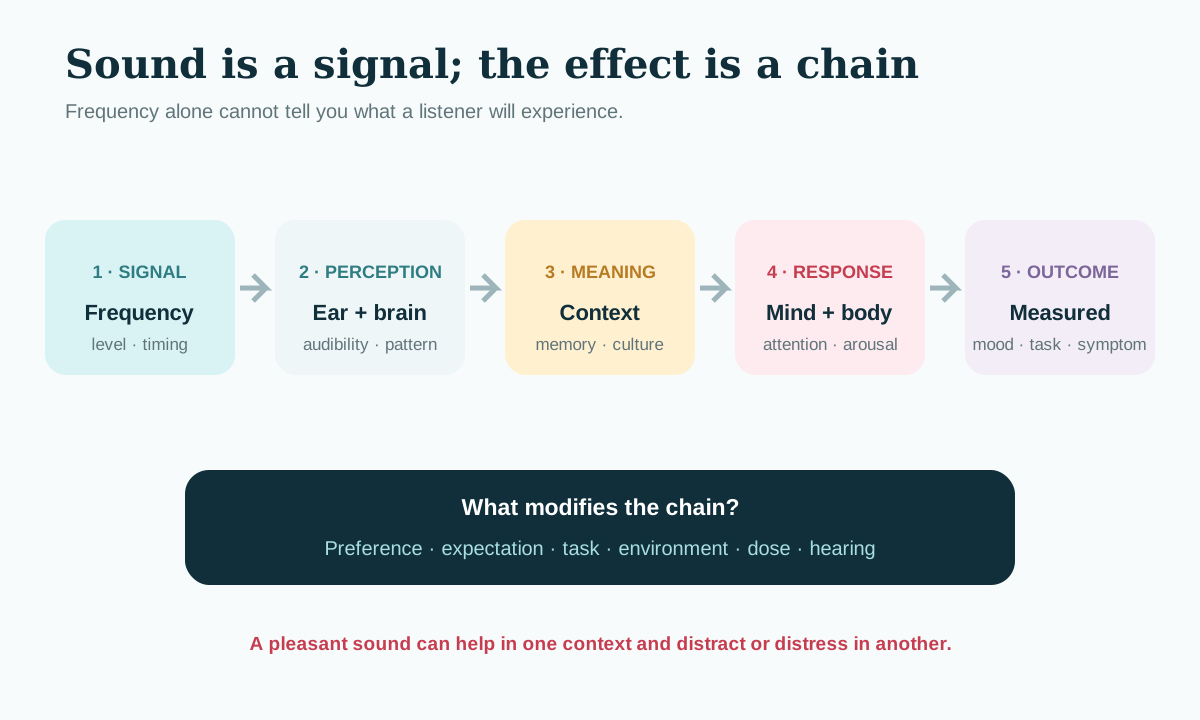
A sound begins as pressure variation, but experience is constructed by the auditory system and wider brain networks. Attention, prediction, memory and context help determine whether a signal feels safe, meaningful, annoying or irrelevant. The same rain recording can mask traffic for one listener and keep another alert.
2. Music can change arousal without acting like a drug
Across 104 randomised trials, a 2020 meta-analysis found average reductions in physiological and psychological stress outcomes from music interventions. Effects differed by outcome and study. Music may influence arousal, reward, expectation, breathing pace, memory and perceived control. Those overlapping routes are more plausible than one song directly correcting a hormone or organ.
3. Choice can matter
Self-selected music may be more acceptable and predictable, while unfamiliar music can demand attention. Preference is not the only variable: lyrics may compete with reading, a beloved song may evoke grief, and highly stimulating music may suit exercise better than bedtime. The useful question is “what happens for this person during this task?”
4. Natural sound is partly about what it replaces
A synthesis of 36 publications found aggregate evidence that natural sounds reduced stress and annoyance and supported positive affective or health outcomes. The comparison conditions varied. Birdsong in a quiet park, water masking mechanical noise and a recording played in a laboratory are different exposures. Natural sound can support restoration without being a substitute for access to healthy environments.
5. Rhythm can organise timing
A steady pulse can cue walking, coordinated movement, breathing or group participation. This is why rhythm is used in rehabilitation and music therapy. Binaural beats are a different phenomenon: two slightly different tones presented separately to each ear create a perceived beat. Reviews report mixed or low-certainty findings across attention, memory, anxiety and pain. A labelled “theta” track is not evidence that the brain has entered one uniform theta state.
6. Silence and noise are also interventions
Removing an unpredictable alert, moving away from a loudspeaker or adding acoustic absorption may help more than adding another track. Continuous masking can be useful, but it may obscure alarms, conversation or environmental cues. People with tinnitus, hyperacusis, migraine, sensory sensitivities or trauma associations may need lower levels, more control and the option to stop immediately.
7. Dose sets the safety boundary
Hearing risk rises with both sound level and duration. The World Health Organization gives 80 dB for up to 40 hours per week as an adult reference exposure; at 90 dB, the equivalent allowance falls to four hours. Actual headphone output varies by device, fit and recording, so a volume percentage is only a rough proxy. Use exposure monitoring where available, choose well-fitting or noise-cancelling headphones in noisy places, take breaks and move away from loud sources.
| Goal | A useful test | Stop or change if… |
|---|---|---|
| Settle after stress | Compare five quiet minutes with five minutes of chosen sound | Arousal or irritation rises |
| Focus on a task | Compare silence, non-lyrical sound and usual audio | Errors or rereading increase |
| Support sleep routine | Use a low-level timer and stable track | It delays sleep or masks important cues |
| Explore a binaural beat | Treat it as an optional audio condition, not a diagnosis | Headache, dizziness or discomfort appears |
When symptoms need assessment
Persistent tinnitus, muffled hearing, sound sensitivity, ear pain, drainage or difficulty following conversation deserve hearing or medical assessment. Sudden hearing loss—especially in one ear—is urgent. Sound-based wellbeing practices should not delay evidence-based care for anxiety, pain, sleep or neurological symptoms.
Sources and further reading
- Saskovets et al. (2025): Sound interventions and adult stress—scoping review
- de Witte et al. (2020): Music interventions and stress—two meta-analyses
- Buxton et al. (2021): Natural sounds and health outcomes
- Basu and Banerjee (2023): Binaural beats, memory and attention—systematic review and meta-analysis
- World Health Organization: Safe listening