Walking Counts: The Health Value of Everyday Movement
Walking counts before it becomes a workout. Learn what step totals, pace and short movement breaks can—and cannot—tell you, and how to build a useful habit from your own baseline.
 Priya ShahMovement & Mobility editor5 September 2026
Movement & Mobility · Explainer
Walking does not become worthwhile only when it is fast, long or recorded as a workout. Trips to the shop, short breaks from sitting and deliberate brisk walks all count as movement—and different doses can serve different purposes.

In short
- Some physical activity is better than none, and benefits begin below a perfect weekly target.
- Step counts are useful feedback, not a universal prescription; 10,000 is not a biological threshold.
- Pace changes the training effect, but light walking still replaces sedentary time.
- Walking supports aerobic activity; strength, balance and mobility may still need separate attention.
Movement does not need workout status
Physical activity means moving the body and using more energy than at rest. Exercise is the planned, structured subset. A walk to the station is physical activity even if it never appears in a training plan. So are repeated trips up the stairs, walking while making a call and taking a ten-minute loop after lunch.
This distinction matters because an all-or-nothing definition erases much of daily movement. Someone who cannot protect a continuous 45-minute workout may still accumulate useful activity in shorter periods. Current public-health guidance no longer requires aerobic activity to occur in bouts of at least ten minutes before it “counts.”
What walking can contribute
Regular physical activity is associated with lower risk of cardiovascular disease, type 2 diabetes, depression, falls and premature death, while also supporting sleep and physical function. Walking is not uniquely responsible for all of these outcomes; it is one accessible way to accumulate activity.
One session can also have near-term effects. Depending on intensity and the individual, a walk may improve mood, interrupt prolonged sitting or reduce the glucose rise after a meal. A randomised crossover study in adults with type 2 diabetes found that three ten-minute walks after meals improved post-meal glucose more than one nonspecific 30-minute daily-walking prescription. That finding is useful, but it does not make walking a replacement for medication or individual diabetes care.
There is no magic step threshold
The 10,000-step goal is memorable, but it is not the line between ineffective and effective days. In a pooled analysis of 15 cohorts, mortality risk declined as daily steps increased, with the association levelling at roughly 6,000–8,000 steps in adults aged 60 and over and around 8,000–10,000 in younger adults. This was observational evidence: it describes associations and cannot prove that steps alone caused the difference.
A US cohort analysis also found lower ten-year mortality among people who reached at least 8,000 steps on only one or two days per week compared with those who did not reach that level on any day. The message is not that 8,000 is compulsory. It is that an imperfect week can still contain meaningful movement.
Start from your own baseline. Moving from 2,500 to 4,000 average daily steps may be a substantial change; a person already at 9,000 may benefit more from adding pace, hills or strength work than from chasing a larger number.
Pace answers a different question
At a light pace, you can usually talk and breathe without effort. At moderate intensity, breathing and heart rate rise; you can talk, but singing would be difficult. This “talk test” is more adaptable than a fixed speed because hills, heat, fitness, disability and medication all change the effort required.
The World Health Organization recommends 150–300 minutes of moderate-intensity aerobic activity per week for adults, or 75–150 minutes of vigorous activity, plus muscle-strengthening work on at least two days. It also emphasises that any amount is better than none and that people should build gradually.
Not every step will meet the moderate-intensity target. That does not make lighter walking wasted. It still breaks up sitting and increases total movement, while brisker periods create a stronger aerobic stimulus.
Four useful kinds of walk
| Walk | Primary purpose | Simple way to use it |
|---|---|---|
| Movement break | Interrupt prolonged sitting | Two to five minutes between blocks of desk work |
| Transport walk | Build activity into an existing journey | Get off one stop earlier or park farther away |
| Post-meal walk | Gentle movement and possible glucose benefit | Ten comfortable minutes after a suitable meal |
| Brisk training walk | Aerobic fitness | Intervals or a sustained pace that passes the talk test |
Make the environment do some of the remembering
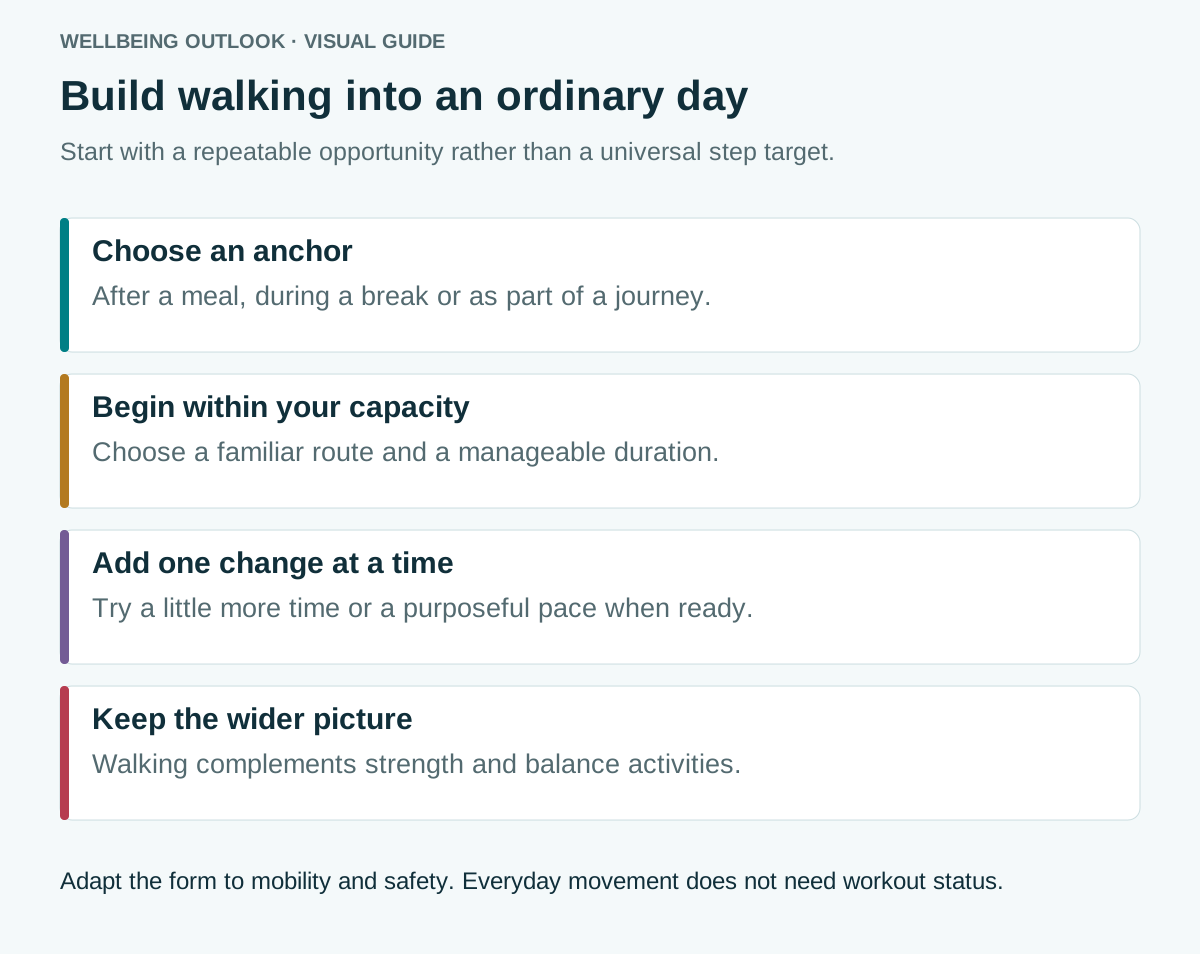
Motivation is unreliable when the cue is vague. Attach walking to something that already happens: the end of lunch, the school run, a recurring call or the moment the laptop closes. Keep shoes and weather gear where the decision occurs. Choose a safe indoor route for poor weather or limited daylight.
Step counters can reveal patterns, but they are imperfect. Wrist devices may miss pushing a pram or using walking aids, while phone counts depend on carrying the phone. Treat the number as a repeatable estimate from one device, not a clinical measurement or a grade.
A progressive two-week start
- Observe three ordinary days without trying to impress the tracker.
- Choose one repeatable five- or ten-minute walking opportunity.
- Repeat it on four days in the first week.
- In week two, add a second short opportunity or make part of one walk brisker.
- Keep one easier day and notice feet, joints, sleep and overall fatigue.
If the increase causes pain that changes your gait or persists, reduce the dose and investigate rather than pushing through. Progress can mean greater consistency, not only more distance.
Walking is foundational, not complete
Walking challenges the heart, lungs and lower-body endurance, especially when pace or gradient rises. It may not provide enough resistance to maintain strength across all major muscle groups. Carrying, pushing, pulling, rising from a chair and structured resistance exercises add capacities that ordinary level walking may miss.
Older adults and people at risk of falls may also need balance practice. Mobility work can be useful when a limited range of motion prevents comfortable steps. A good programme can therefore use walking as its daily floor while adding smaller doses of strength and balance.
Accessibility changes the form, not the principle
Not everyone can walk, and walking language should not define movement as a moral achievement. Wheelchair propulsion, seated aerobic activity, assisted movement and other adapted options can provide meaningful physical activity. A physiotherapist or suitably qualified exercise professional can help match activity to pain, fatigue, neurological conditions or disability.
When to pause and seek advice
Stop and seek urgent assessment for chest pressure, fainting, severe breathlessness out of proportion to effort or new neurological symptoms. New calf swelling or significant pain also deserves medical attention. People returning after surgery, an acute cardiac event or a major period of illness should follow their clinical plan rather than a generic step challenge.