Why We Dream: Leading Ideas Without a Final Answer
Dreams recombine memory and emotion, but no single theory explains why we dream or whether the remembered experience itself performs a function.
 Elena MoralesSleep & Recovery editor5 September 2026
Sleep & Recovery · Explainer
Dreams are vivid products of a sleeping brain, but science has not settled on one reason for them. Memory, emotion, threat rehearsal and spontaneous brain activity may all contribute.

In short
- No single theory explains every dream.
- Dream content often recombines recent concerns, older memories and emotion.
- REM sleep supports important brain functions, but that does not prove that remembered dreams themselves cause those benefits.
- Occasional vivid or unpleasant dreams are common; persistent distress deserves attention.
First, separate sleep from dream recall
Researchers can measure sleep stages with brain activity, eye movements and muscle tone. A dream, however, is known mainly through a report after awakening. People can dream without remembering it in the morning, and an awakening changes what can be reported. That makes dream science unusually difficult: the event happens in sleep, while the evidence is collected awake.
Vivid, story-like reports are frequent after rapid-eye-movement sleep, when the brain is active and muscle tone is low. Yet dream-like thought also occurs in non-REM sleep. REM is therefore neither a perfect synonym for dreaming nor the only place where it happens.
Idea one: memory sorting and integration
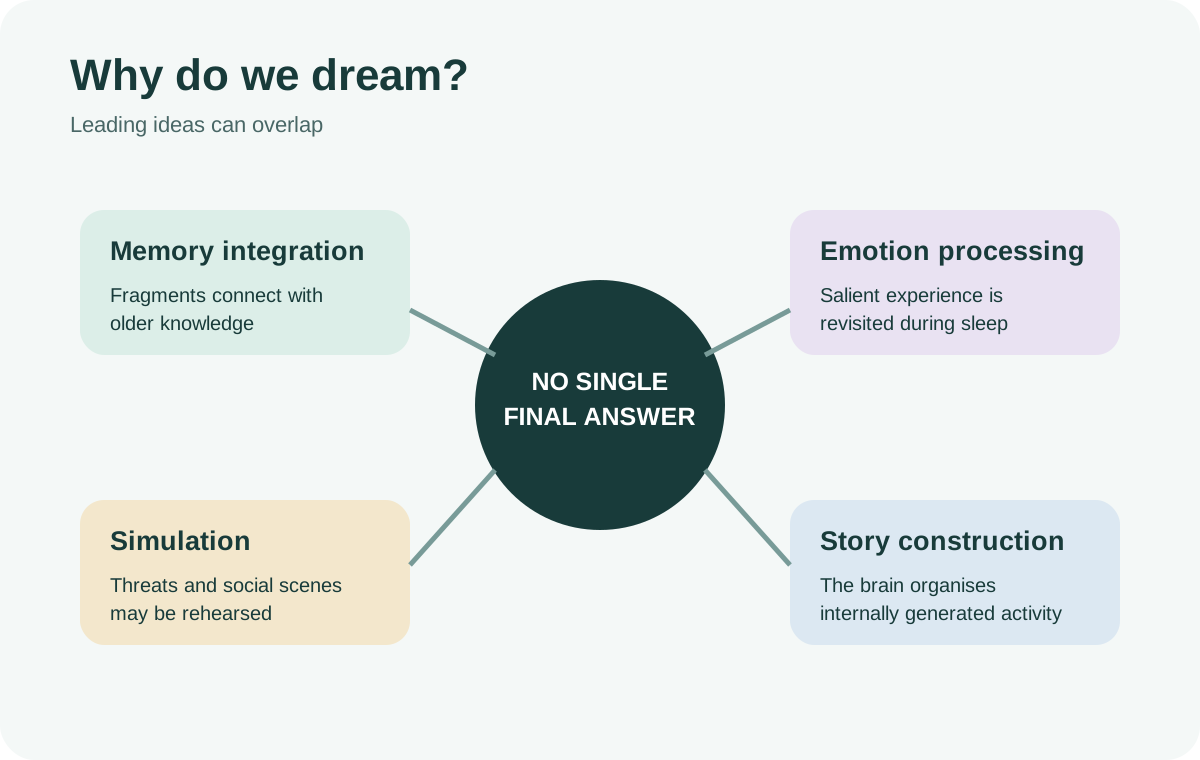
Sleep helps stabilise and reorganise memories. Dreams often contain fragments of recent life, but rarely replay events exactly. One proposal is that dream experience reflects the brain reactivating and integrating information with older networks. The loose associations and narrative jumps may be a glimpse of that process.
The careful wording matters. Evidence that sleep supports memory is strong; evidence that the conscious dream story is required for memory consolidation is much less direct. A dream may accompany the work rather than do the work.
Idea two: emotional processing
Dreams frequently carry strong emotion and personally salient themes. Reviews have linked REM physiology, dream recall and emotional-memory processing. A 2024 experiment also associated dreaming with changes in emotional memory, an intriguing result that needs replication and does not establish a universal purpose.
This idea does not mean every nightmare is therapeutic or that a symbolic interpretation is scientifically correct. Emotional material can be processed in many ways, and distressed sleep can worsen daytime wellbeing.
Idea three: simulation
Threat-simulation theories propose that dreams provide a virtual arena for rehearsing danger. Broader social-simulation accounts include affiliation, conflict and attachment. The recurrent appearance of pursuit, failure and social evaluation is compatible with these views, but compatibility is not proof. Cultural context, waking concerns and the ease of remembering dramatic content can produce similar patterns.
Idea four: the brain making a story
During sleep, internally generated signals continue while sensory input and executive control change. The sleeping brain may weave this activity into a best-fit experience. This family of accounts explains discontinuity and bizarre combinations without assigning every scene a hidden message. It does not rule out memory or emotional functions elsewhere in sleep.
Why there is no final answer
Theories operate at different levels. One describes neural activity, another describes content, and another proposes an evolutionary advantage. They are not always direct competitors. Studies also depend on awakening schedules, self-report, small samples and selective recall. Laboratory dreams may differ from dreams remembered naturally at home.
A useful conclusion is plural and provisional: dreams are constructed from an active sleeping brain; waking memories and emotions influence them; and their precise causal function remains unsettled.
What to do with your own dreams
You can treat a dream as personal material without treating it as diagnosis or prediction. A brief note may reveal recurring concerns, but fixed dictionaries that assign one meaning to every image are not evidence-based. Ask what the dream evokes for you rather than what it supposedly proves.
For better recall, write immediately after waking before checking messages. Record emotion, people and setting before forcing a coherent plot. If recall becomes a performance target that disrupts sleep, let it go.
When dreams need clinical attention
Seek professional advice when nightmares are frequent, cause fear of sleep, follow trauma, or produce substantial daytime impairment. Acting out dreams with shouting, punching or leaving the bed can signal REM sleep behaviour disorder and warrants medical assessment, particularly when it begins later in life. New dream disturbance after a medicine change should also be discussed with the prescriber rather than prompting abrupt discontinuation.