Why Your Mind Can Stay at Work After the Laptop Closes
Closing the laptop does not always end the workday mentally. Unfinished tasks, emotional rumination and blurred boundaries can keep work active—and a better shutdown ritual can help contain it.
 Daniel OkaforStress & Emotional Health editor5 September 2026
Stress & Emotional Health · Feature
The laptop is closed, but your mind is still rehearsing conversations, reopening decisions and scanning tomorrow’s list. That does not mean you are bad at relaxing. It often means the working day ended without giving the brain a convincing signal that the work was contained.

In short
- Unfinished tasks are associated with more work-related thought during time off.
- Affective rumination—replaying work with tension or frustration—is more disruptive than calm problem-solving.
- Detachment is not forgetting your responsibilities; it is temporarily releasing the demand to act on them.
- A reliable shutdown ritual can reduce ambiguity by recording what remains open and defining the next action.
The workday can end administratively before it ends mentally
Modern work rarely delivers a clean finishing bell. A message arrives at 17:58. A document remains half written. A difficult conversation has no obvious resolution. Even when no one explicitly asks you to keep working, communication tools leave the door open.
The mind treats unresolved demands differently from completed ones. A 2026 meta-analysis found that unfinished work tasks were positively associated with work-related thoughts during off-job time, with the strongest relationship for affective rumination. Earlier diary research also linked unfinished tasks with impaired weekend sleep through rumination.
This is sometimes described through the Zeigarnik effect: incomplete goals remain cognitively accessible. The useful point is not that every unfinished task will haunt you. It is that uncertainty can keep a goal “active” when your brain has not been told where the task now lives or when attention will return to it.
Not every work thought is the same
Affective rumination
This is the tense loop: “Why did they say that?”, “I should have answered differently,” or “I will never finish.” The thought carries emotional activation and usually does not produce a useful decision. It can feel urgent while remaining repetitive.
Problem-solving pondering
This is more neutral and sometimes constructive: an idea develops during a walk, or a solution appears in the shower. It can still occupy off-job time, but it does not necessarily have the same relationship with poor recovery as affective rumination.
Psychological detachment
Detachment means mentally disengaging from work during non-work time. It is not apathy. You can care deeply about your work and still allow the systems supporting attention and emotion to recover. Across many studies, better detachment is associated with less exhaustion, better sleep and higher wellbeing, although effects vary and most findings do not prove a single cause.
Why “just relax” usually fails
A command to relax gives the mind no answer to its practical questions. Is the task safe to forget? Has the risk been recorded? What happens first tomorrow? If those questions remain open, trying to suppress the thought can become another struggle.
A transition works better when it addresses both the unfinished work and the body’s momentum. The cognitive system needs containment. The nervous system needs a change in cues: posture, light, movement, breathing, sound or location.
A seven-minute shutdown sequence
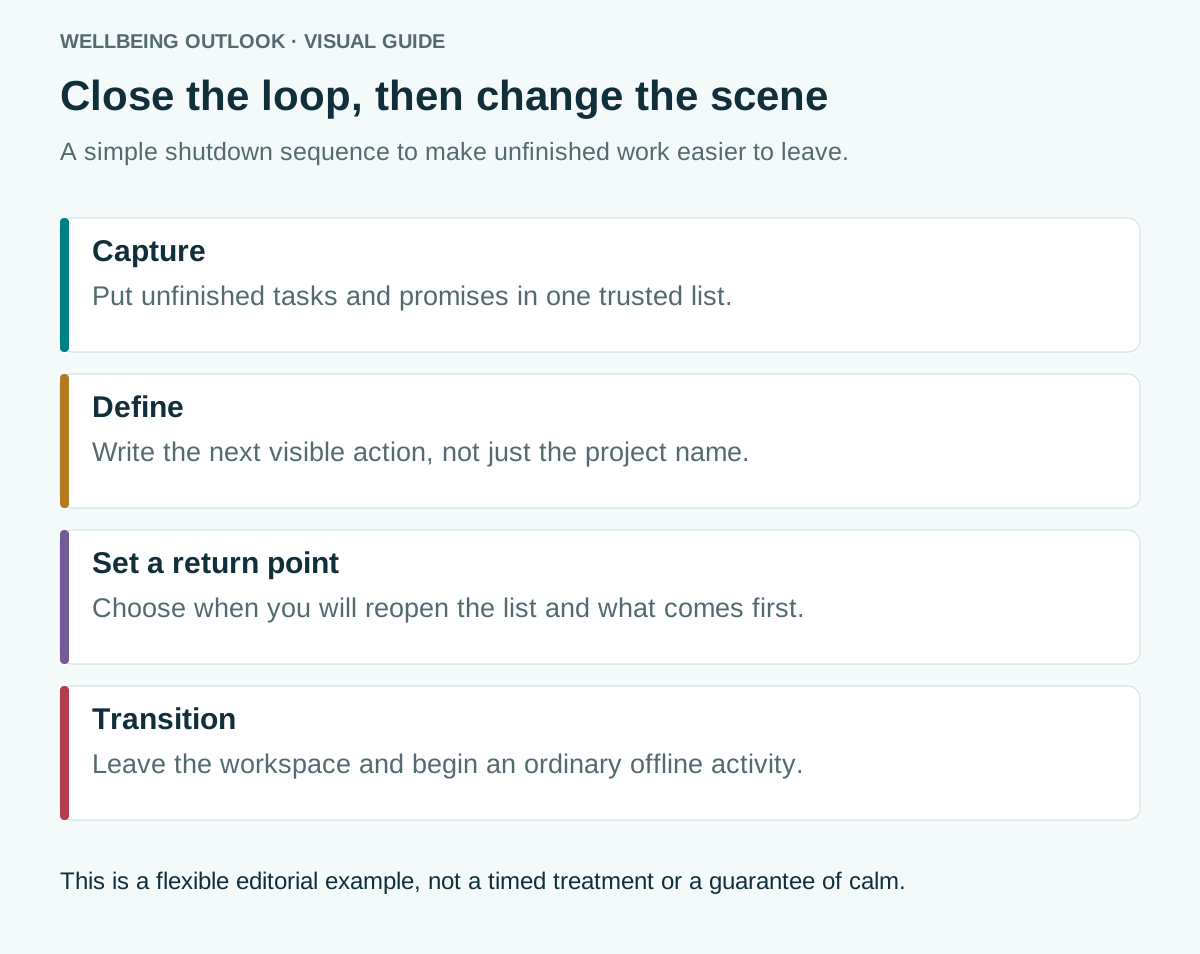
- Capture every open loop. Write incomplete tasks, promises and worries in one trusted place.
- Define the next visible action. Replace “presentation” with “draft the three slide headings.” Specificity reduces the need to keep rehearsing.
- Choose tomorrow’s first task. Decide before your tired evening brain tries to solve the entire week.
- Send only genuinely time-sensitive messages. Do not manufacture closure by opening five new conversations.
- Write a return sentence. “I will reopen this list at 09:00.” It is a boundary, not a promise that everything is complete.
- Change the sensory scene. Stand, leave the workspace, wash your face, walk briefly or play a consistent transition track.
- Do one embodied activity. Prepare food, stretch, shower or speak to someone without simultaneously checking work.
When the loop comes back
Do not debate every returning thought. Ask one question: “Is there new information that changes tomorrow’s plan?” If yes, add one line to the capture list. If no, label it as a replay and return attention to the current activity.
The goal is not perfect mental silence. A successful transition may simply mean that work thoughts become less sticky and no longer dictate the entire evening.
Three common traps
Using entertainment as an immediate anaesthetic
Going straight from the final email into fast scrolling can change the content of attention without creating recovery. The mind remains in a rapid-response mode: novelty, alerts and unresolved choices continue arriving. Entertainment can absolutely belong in an evening, but a short low-input transition first may make it feel restorative rather than compulsive.
Trying to finish everything before stopping
Knowledge work expands. There is nearly always another message, improvement or preparation that could be completed. If permission to stop depends on an empty list, stopping becomes impossible. A defined daily boundary is more realistic than total completion.
Turning relaxation into another performance metric
Checking every few minutes to see whether you are calm keeps attention on the problem. Use a process target instead: complete the shutdown list, spend ten minutes away from screens, or listen to one transition track. Let the nervous system change at its own speed.
A worked example
Imagine finishing with an unanswered client question, an incomplete report and a tense meeting still replaying. “Stop thinking about work” gives none of them a destination. A containment note might read:
- Client: verify the delivery date at 09:15, then reply.
- Report: draft the results heading before the 11:00 meeting.
- Meeting: decide tomorrow whether a clarification is needed; no action tonight.
The workload has not vanished, but the mind no longer needs to rehearse all three items to prevent them from being lost. The note creates an external memory and a return point. The following walk, shower or audio session can then perform a different job: changing state rather than storing tasks.
Digital boundaries that are realistic
Turning off every device is not possible for everyone. Choose the smallest boundary that protects recovery:
- remove work mail from the home screen;
- mute non-critical channels after a defined time;
- use separate browser profiles for work and personal use;
- keep the laptop physically out of the relaxation space;
- agree what “urgent” means with colleagues before an urgent situation occurs.
Boundaries work best when the organisation supports them. An individual ritual cannot compensate indefinitely for excessive workload, unpredictable scheduling or an expectation of constant availability.
What improvement looks like
Look for a trend across two weeks, not a perfectly empty mind on day one. Useful signs include fewer unplanned inbox checks, shorter rumination loops, easier engagement with family or leisure, and less work-related activation at bedtime. If a ritual becomes elaborate enough to create more pressure, simplify it. The minimum effective version may be three written next actions and a five-minute walk.
When it may be more than a transition problem
Persistent rumination can overlap with anxiety, depression, burnout symptoms or insomnia. If work thoughts regularly prevent sleep, trigger panic, impair relationships or continue despite reasonable boundary changes, consider speaking with a qualified health professional. The problem is not a personal failure to perform relaxation correctly.