Zone 2 Cardio: Useful Concept or Fitness Fashion
Zone 2 is a useful name for sustainable aerobic work, not one universal heart-rate number or an exclusive route to adaptation.
 Priya ShahMovement & Mobility editor5 September 2026
Movement & Mobility · Debunk
Zone 2 is a useful name for sustainable aerobic work below the first threshold. It is not one universal heart-rate number, and the adaptations are not exclusive to a narrow zone.

In short
- Experts commonly place Zone 2 just below the first lactate or ventilatory threshold.
- Watch systems use different zone models, so “Zone 2” may mean different intensities.
- The talk test and rating of perceived exertion are often more useful than a generic percentage formula.
- Health benefits come from the total pattern of activity, not perfect time in one band.
Why the label became confusing
Three-zone physiology models, five-zone heart-rate systems and branded watch algorithms use the same words differently. In a five-zone model, Zone 2 is often easy-to-moderate endurance work. In a three-zone research model, Zone 2 can mean the region between first and second thresholds—a considerably harder domain.
When someone prescribes Zone 2, ask which model and how boundaries were set. A screenshot without that context is not a transferable training plan.
The physiological anchor
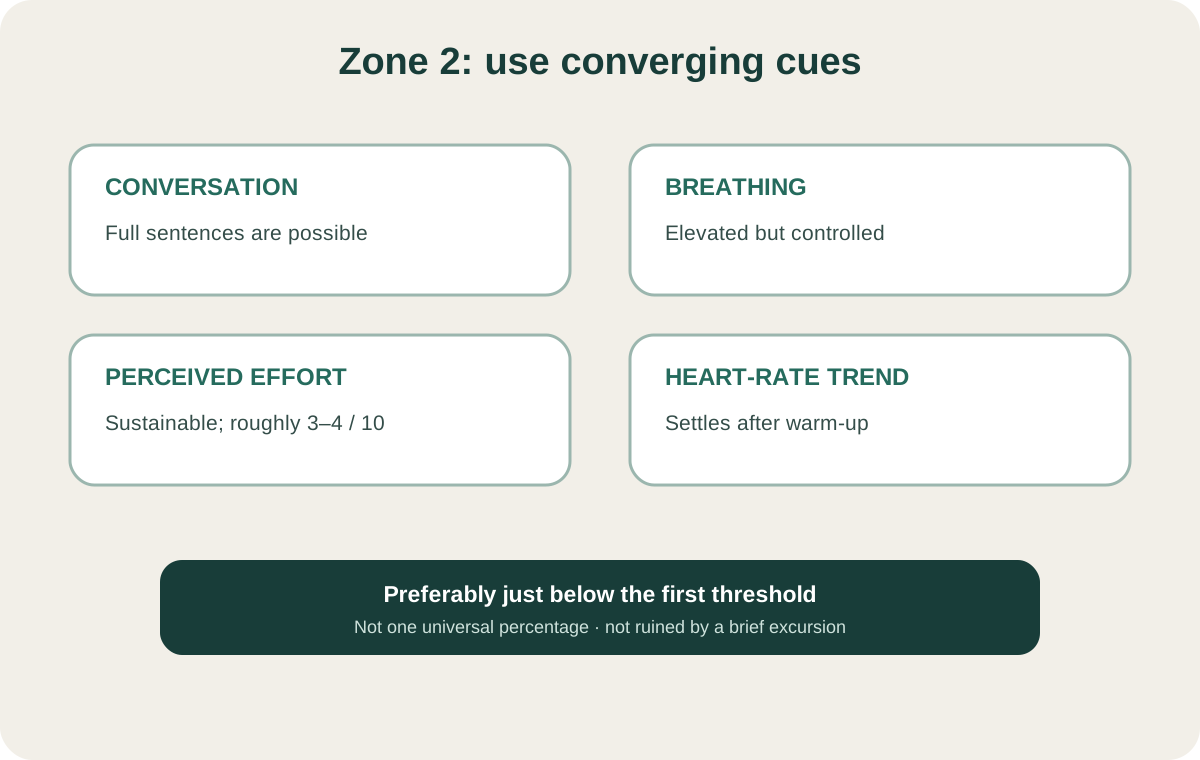
A 2025 expert viewpoint reached consensus that Zone 2 should preferably sit immediately below the first lactate or ventilatory threshold. Below this transition, breathing and lactate remain relatively stable and prolonged work is possible. The threshold is individual and can shift with training, fatigue, heat and illness.
Expected adaptations include changes in mitochondrial function, fat oxidation, capillaries and cardiovascular capacity. Experts also emphasised that these adaptations are not necessarily unique; work slightly below or above can produce overlapping changes.
How to estimate it without a laboratory
Use a pace at which you can speak in full sentences, breathing is clearly elevated but controlled and effort feels sustainable. On a zero-to-ten scale, many people experience this as roughly three or four, but words and scales vary. After warming up, heart rate should settle rather than climb rapidly at unchanged workload.
Generic percentages of maximum heart rate are population estimates. A predicted maximum can be wrong for an individual, and medicines such as beta blockers change the response. Treat wearable zones as starting hypotheses.
What a useful session looks like
Choose walking uphill, cycling, swimming, rowing or another rhythmic mode you can perform comfortably. Warm up gradually. Continue at steady conversational effort for a duration appropriate to your current capacity, even if that is ten minutes. Increase weekly volume before obsessing over precision.
For general health, follow public-health guidance for moderate and vigorous aerobic activity plus strength work. Zone 2 can contribute to the moderate volume; it does not replace resistance training, balance, higher-intensity work when appropriate or everyday movement.
Where the fashion goes wrong
Claims that only Zone 2 burns fat confuse fuel use during a session with body-fat change over time. Claims that everyone needs hours of it ignore training history and available time. Claims that brief excursions above the boundary “ruin” the workout turn physiology into superstition.
Elite endurance athletes often perform substantial easy volume because they train many hours and must manage fatigue. Copying their percentage distribution without copying their goals, recovery and total volume is poor reasoning.
Progress and measurement
Repeat a familiar route or bike workload under similar conditions. Over weeks, you may move faster or produce more power at a similar conversational effort and heart rate. Day-to-day changes reflect heat, sleep, hydration, stress and measurement error, so follow trends.
Chest straps are often more responsive than wrist sensors, but no device can define your threshold perfectly from one session. Laboratory testing is most useful when precision changes a high-level training decision.
Safety
Stop for chest pressure, faintness, unusual severe breathlessness, palpitations with symptoms or neurological signs. People with cardiovascular, pulmonary or metabolic disease, or a long period of inactivity plus symptoms, may need clinical guidance before progressing. Easy-looking exercise is still exercise.